From Epic Object to Museum Artifact
The journey of this box to the Met Cloisters is itself a very typical story of how medieval objects survived into the modern world—quietly, indirectly, and often without continuous documentation. According to the gallery label, the box was part of a private collection in the United Kingdom before entering the museum. That single line actually compresses several centuries of movement, ownership, and changing meaning. Objects like this rarely traveled in straight lines. After its creation in southern France around 1200–1225, the chest would have remained in private hands for generations, valued not as “art” in the modern sense but as a useful and symbolic household object, something that stored valuables while simultaneously broadcasting cultural identity and heroic memory.
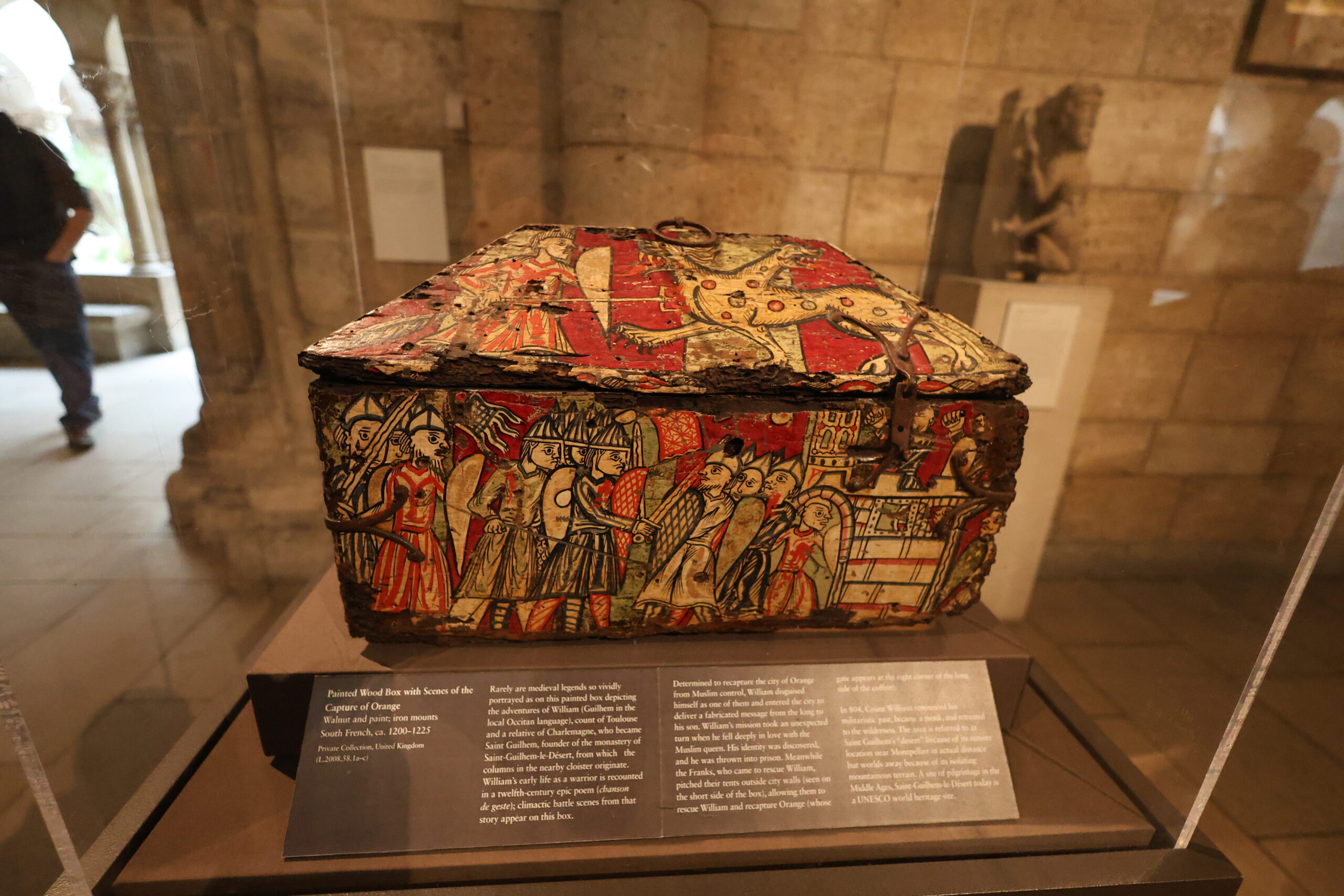
By the late Middle Ages and into the early modern period, many such painted wooden objects lost their original narrative relevance. The chansons de geste faded from everyday performance, saints replaced heroes, and tastes shifted. Boxes survived precisely because they were practical. When they were no longer fashionable, they were reused, repainted, stored, or simply forgotten in estates, monasteries, or town houses. The fact that this one retained so much of its original paint suggests long periods of careful keeping, likely by families who understood it as an heirloom rather than as furniture to be modernized. At some point—probably in the nineteenth or early twentieth century, when medieval art became highly collectible—it entered the antiquities market and passed into a British private collection, where such objects were actively sought by collectors fascinated by medieval romance and chivalric culture.
Its arrival at the Met Cloisters fits squarely within the institution’s founding logic. The Cloisters was conceived in the early twentieth century as a space that would reunite medieval European architecture and objects in an immersive, narrative environment. Curators were not only interested in monumental sculpture or manuscripts but also in everyday objects that revealed how medieval people lived with stories, beliefs, and symbols around them. A painted box illustrating the Capture of Orange was almost perfect for this vision: portable, narrative-driven, and rooted in the lived culture of medieval France. Whether acquired through donation or purchase—both were common routes—the box was selected because it speaks across categories: art, literature, history, and domestic life.
Once installed at the Cloisters, the box changed status again. It ceased to be a private heirloom and became a historical document, framed by scholarship and contextual labels. Yet it still performs a role similar to the one it played eight centuries ago. It tells a story visually, without demanding literacy, and it invites viewers to lean in, trace figures with their eyes, and reconstruct an epic from fragments. Its presence at the Cloisters is not accidental or decorative; it is the final stage, so far, in a long migration from medieval household object to curated witness of how history was once imagined, painted, and kept close at hand.
A Painted Chest and a Captured City
The object sits quietly behind glass, small enough to feel almost domestic, yet dense with conflict, storytelling, and medieval bravado. This painted wooden box—its surface worn, chipped, and softened by centuries—feels less like a container and more like a frozen moment pulled straight out of a 13th-century chanson de geste. The reds dominate immediately, not a clean modern red but a deep, earthy pigment that has aged into something warmer, almost bruised. Across its sides, rows of armored figures march in profile, their faces stylized and solemn, shields lifted, spears angled forward as if the box itself is advancing. The repetition of helmets and banners gives a rhythm to the scene, like a visual drumbeat of an army on the move. On the lid, the story escalates: a mounted figure, heroic and oversized, charges across the surface, the horse’s body dotted with decorative marks that blur the line between realism and symbol. Everything is outlined in confident black lines, the medieval equivalent of bold typography, meant to be read from a distance, meant to last.
Up close, the imperfections start to speak louder than the narrative. The wood has warped slightly; the lid no longer sits perfectly flush, as if time itself pried it open again and again. Cracks run through painted faces and shields, splitting warriors in half, yet somehow enhancing the sense that this is history under pressure rather than decay. A simple iron latch hangs at the front, functional, unpretentious, a reminder that this box once had a job beyond storytelling—it held something valuable, something worth protecting. The label beneath mentions the Capture of Orange, a medieval tale rendered not on parchment but on an everyday object, turning legend into furniture, propaganda into personal possession. It’s striking to realize that these scenes were not meant to be rarefied museum art; they were part of daily life, carried, opened, touched, maybe argued over.
The setting amplifies the mood. The stone walls behind the case echo the same medieval logic as the box itself—thick, functional, indifferent to comfort. Soft light glances off the glass, catching reflections of passersby who briefly overlap with the painted soldiers, modern silhouettes drifting through an old war. Somewhere in the background, a carved stone figure watches from its own pedestal, adding another layer of time to the room. Standing there, you get the odd sense that the box is still doing what it was designed to do: preserving a story, guarding it, waiting patiently for someone to stop, lean in, and read it again—cracks, faded reds, and all.
The Capture of Orange: A Chanson de Geste in Wood and Paint
The text beneath the box anchors what at first feels like a fragment of legend firmly in time and place. This painted wooden chest, made of walnut with iron mounts in southern France around 1200–1225, tells the story of the Capture of Orange, one of the most popular episodes in the medieval epic cycle surrounding William of Orange—Guillaume d’Orange in the original Old French tradition. William was not an invented fairy-tale hero but a semi-legendary Frankish nobleman, a kinsman of Charlemagne, whose historical shadow was gradually reshaped by poets into a larger-than-life defender of Christendom. By the early thirteenth century, his exploits had become canonical material in chansons de geste, long narrative poems performed aloud, memorized, and endlessly reworked. This box does not simply illustrate history; it illustrates how history was remembered, dramatized, and emotionally consumed.
The episode depicted here focuses on William’s campaign to seize the city of Orange from Muslim rulers, a story that blends military action with deception and personal sacrifice. According to the legend summarized on the label, William enters Orange not through open battle but through cunning: he disguises himself as a Muslim convert and infiltrates the city, delivering a fabricated message from the king of Toulouse. Once inside, he reveals his true identity, is captured, imprisoned, and condemned to death. The drama intensifies when William is thrown into prison and tortured, only to be rescued at the last moment by his loyal companions. The painted ranks of soldiers along the sides of the box correspond to this martial tension—the steady, anonymous mass of fighters that frames William’s singular heroism. On the lid, the mounted figure represents the climactic reversal: William freed, triumphant, retaking Orange by force and reclaiming it for Christian rule.
What matters here, from a historian’s point of view, is not whether these events occurred as described—they did not—but why they were told this way, and why they were painted onto a domestic object. By 1200, the chansons de geste had become tools of cultural memory, reinforcing ideals of loyalty, Christian identity, and feudal duty at a time when crusading ideology still shaped European politics. William’s willingness to disguise himself, suffer imprisonment, and endure humiliation before victory made him an ideal moral exemplar: clever but devout, violent but justified. The box turns this moral narrative into something intimate. Unlike a manuscript, which required literacy and wealth, a painted chest could be “read” visually by anyone who knew the story. It sat in a home, was opened daily, and quietly repeated the lesson that courage, faith, and endurance would ultimately prevail.
The label’s final lines hint at the long afterlife of this legend. William of Orange became Saint Guilhem, retreating in old age to the monastery of Saint-Guilhem-le-Désert, where his tomb attracted pilgrims. This transformation—from warrior to saint—allowed medieval audiences to reconcile brutal conquest with spiritual redemption. The box captures William in his heroic phase, but the knowledge of his eventual sanctity hovers over the images, giving them retrospective moral legitimacy. Seen this way, the object is not merely decorative. It is a compact, portable monument to how medieval society wanted to understand its past: history filtered through epic, epic domesticated into art, and art folded seamlessly into everyday life.
Orange, in today’s geography, is a real and very tangible place: the town of Orange, located in southern France, in the region historically known as Provence. It sits along the Rhône corridor, north of Avignon, an area that in the early Middle Ages was a strategic crossroads linking the Mediterranean world with inland Frankish territories. This geography explains why Orange looms so large in medieval imagination despite being, by modern standards, a modest town.
In the period evoked by the painted box, Orange was part of a frontier zone. Control over it shifted repeatedly between local lords, Carolingian authorities, and, in epic literature, Muslim rulers imagined as occupying southern cities. The chansons de geste dramatically exaggerate this reality, turning Orange into a symbol rather than a precise political entity: a fortified city at the edge of Christendom, a prize whose capture confirms divine favor and heroic legitimacy. Historically, there is no evidence that Orange was ever ruled by Muslim forces in the way the legend describes, but the town’s position near the Mediterranean world made such stories plausible to medieval audiences, especially during the age of crusades.
Today, Orange is best known not for epic warfare but for its extraordinary Roman heritage, especially the Théâtre antique d’Orange, a UNESCO World Heritage site and one of the best-preserved Roman theaters in Europe. That continuity is striking: the same city that medieval poets imagined as a battleground of faith had already been a major Roman colony centuries earlier, and it survived into the modern era as a provincial town layered with history. When the label on the box speaks of the “Capture of Orange,” it is referring not to an abstract or lost city, but to this very place—real stone, real streets—transformed by medieval storytelling into a stage for heroism, suffering, and ultimate triumph.
Leave a Reply