The photograph catches one of those objects you can walk past for years without really seeing, a four-figure fountain standing quietly in the street, its dark green metal softened by age and weather. Four women stand back to back, arms raised, hands braced beneath a domed canopy, their bodies slightly angled as if the weight is shared rather than imposed. The folds of their garments fall heavily, frozen mid-drape, and the patina settles into every crease, telling a story of sun, rain, and long afternoons when the city barely notices them. The background melts away into pale stone, a palm tree, a parked car, all blurred just enough to let the sculpture claim the moment. Against the clear blue sky, the finial at the top of the dome feels almost defiant, a small upward gesture that survives traffic, heat, and time.
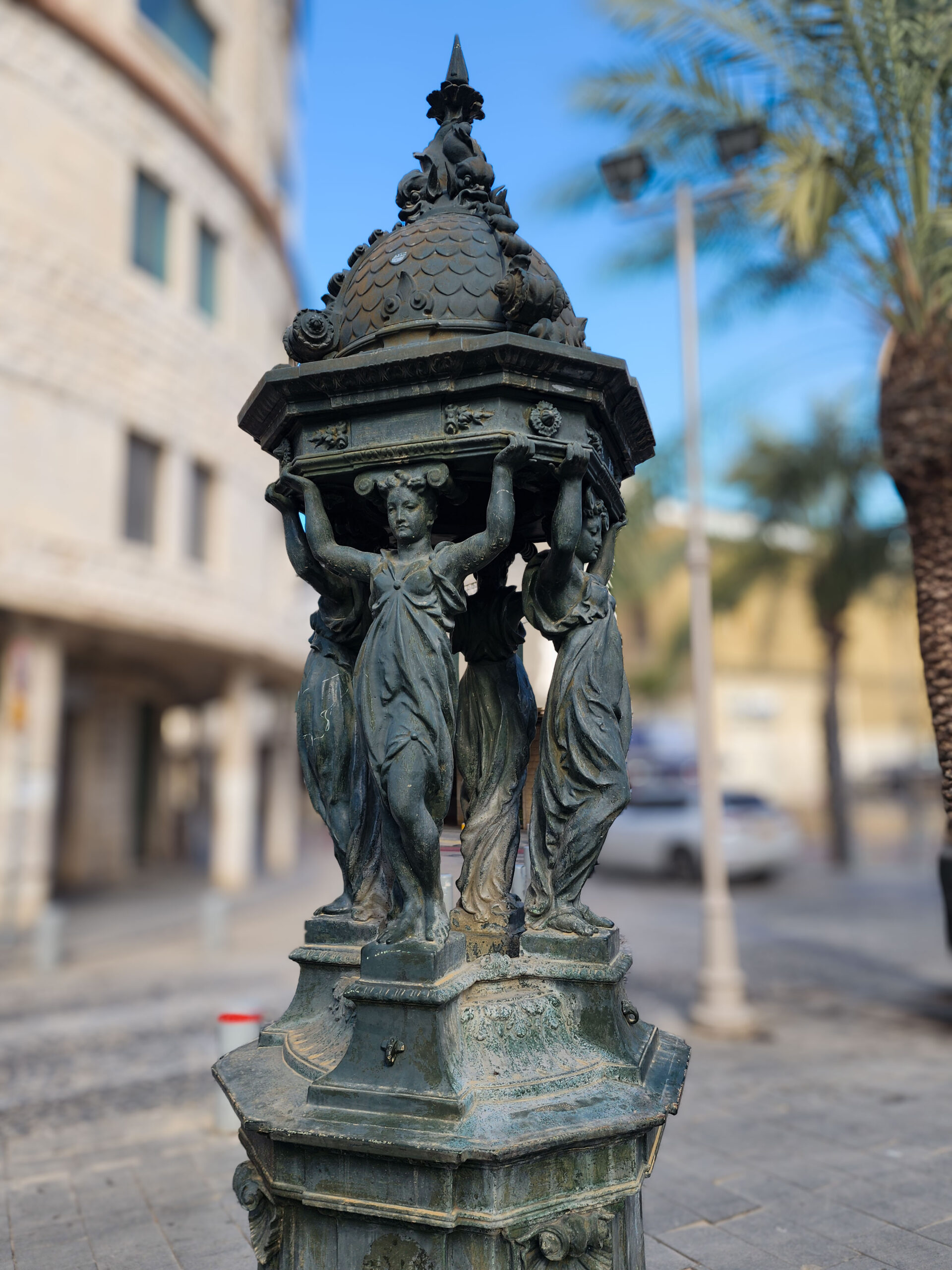
What you’re looking at is a classic Wallace fountain, a design that originated in Paris in the late nineteenth century and spread far beyond France, becoming one of the most recognizable pieces of urban street furniture in the world. The original fountains were commissioned by Sir Richard Wallace after the Franco-Prussian War, at a moment when access to clean drinking water in cities was both a public health issue and a social statement. The sculptural form was created by Charles‑Auguste Lebourg, who chose to combine utility with symbolism, turning a drinking fountain into a small monument that quietly promotes civic values. The four female figures are often described as representing virtues such as kindness, simplicity, charity, and sobriety, which suddenly makes their shared burden feel intentional rather than decorative.
Seen up close, especially through a lens that isolates it from the street, the fountain stops being a historical reference and starts feeling strangely contemporary. The figures don’t strain dramatically; they cooperate. No single body carries the dome alone, and the structure exists only because the load is evenly distributed. That idea lands differently today, in a city where infrastructure is usually invisible until it fails. Originally, water would have flowed from spouts below, turning this sculpture into a practical pause point for anyone passing by, rich or poor, resident or visitor. Even when the water no longer runs, the message still does its quiet work. This isn’t just a relic of nineteenth-century Paris dropped into another city; it’s a reminder that good urban design once assumed care, access, and dignity as defaults. You frame it, you look, you move on, and the four figures stay right there, holding everything up without asking for attention.
Upcoming technology conferences:
- International Compact Modeling Conference, July 30–31, 2026, Long Beach, California
- Israel Tech Week Miami (ISRTW), April 27–30, 2026, Miami, Florida
- Data Centre World London, 4–5 March 2026, ExCeL London
- Hannover Messe: Trade Fair for the Manufacturing Industry, 20–24 April 2026, Hannover, Germany
- DesignCon 2026, Feb. 24–26, Santa Clara Convention Center
- NICT at Mobile World Congress 2026, March 2–5, Barcelona
- Sonar Summit: A global conversation about building better software in the AI era, March 3, 2026
- Cybertech 2026: Proof That the Industry Is Finally Catching Up With Reality
- Chiplet Summit 2026, February 17–19, Santa Clara Convention Center, Santa Clara, California
- MIT Sloan CIO Symposium Innovation Showcase 2026, May 19, 2026, Cambridge, Massachusetts
Leave a Reply