• Skip to main content
  • Skip to secondary menu
  • Skip to footer

Virtual Travel Guide

Top Travel Destinations in Digital Media

  • Sponsored Post
  • About
    • GDPR Compliance Statement
  • Contact

Famous Key Marco Cat on exhibit at Marco Island Historical Museum through 2026

July 12, 2022 By admin

Exhibit includes additional Key Marco artifacts and watercolors
by expedition artist Wells Sawyer

MARCO ISLAND, Fla., July 12, 2022 Marco Island, located on Southwest Florida’s Gulf Coast, is one of the Sunshine State’s most beautiful and desirable tourist destinations. But it is so much more. For hundreds of years, it has held in its earth some of the mysteries of the Island’s ancient peoples — the Calusa and their ancestors.

In 1896, Marco Island revealed one of the most important finds in the history of American archaeology. Smithsonian anthropologist Frank Hamilton Cushing discovered the now world-famous Key Marco Cat and other 500-to-1,500-year-old artifacts on Key Marco during the famed Pepper-Hearst archaeological expedition.

These artifacts of wood and plant fiber were astonishingly well preserved because they were buried in an oxygen free muck. Some were painted and their original colors were still intact.

Many began disintegrating upon exposure to the air. They would have been lost forever if not for expedition artist and photographer Wells Sawyer who captured them in watercolors and photos as they were brought out of the ground.

Now, for the first time since their discovery, the Key Marco Cat and other rare pre-Columbian Native American artifacts discovered with it are reunited at the Marco Island Historical Museum (MIHM). In addition, a number of Sawyer’s original watercolors of the artifacts will be exhibited starting in October.

The Key Marco Cat, on loan to the MIHM from the Smithsonian Institution’s National Museum of Natural History, is on exhibit at MIHM now through 2026.
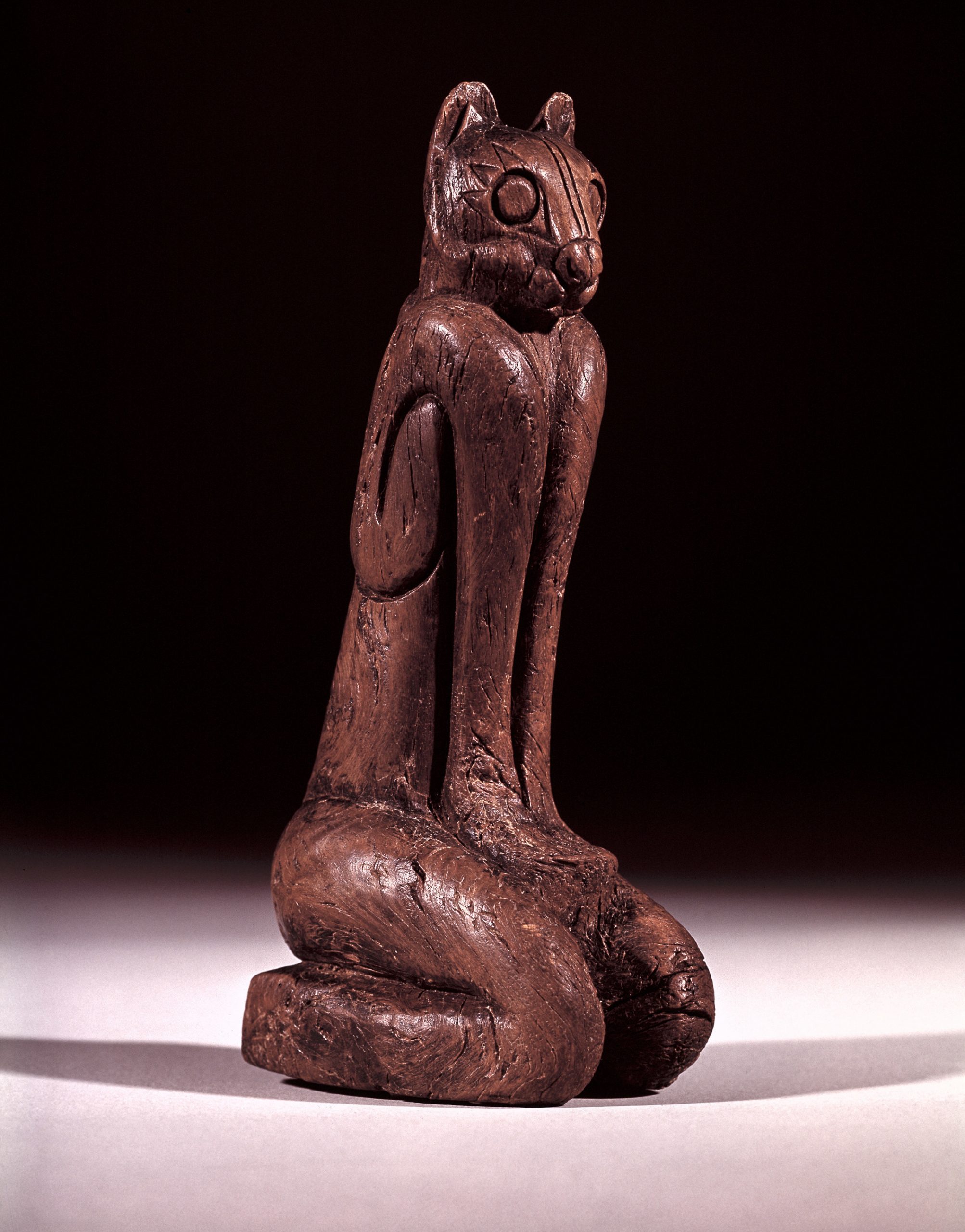
The Key Marco Cat — one of the finest pieces of pre-Columbian Native American art ever discovered in North America — is on exhibit at the Marco Island Historical Museum through 2026. Photo credit: Courtesy of Department of Anthropology, Smithsonian Institution (A240915)

Sixteen additional Key Marco artifacts, on loan from the University of Pennsylvania Museum of Archaeology and Anthropology (Penn Museum), are on exhibit at the MIHM now through April 2024.

In Art of the Dig: Wells Sawyer’s Watercolors, six original Wells Sawyer watercolors are on loan from the Florida Museum of Natural History in Gainesville. In addition, 25 reproductions of Sawyer’s works from the Smithsonian Institution’s National Anthropological Archives and the Penn Museum will be part of the exhibit from October 13, 2022 through January 19, 2023.

The Key Marco Cat, a half cat/half human figure, is considered one of the finest pieces of pre-Columbian Native American art ever discovered in North America. At just six inches tall, the enigmatic feline has captured the public’s imagination for over a century and continues to intrigue all who view it.

The Key Marco artifacts are showcased in the MIHM’s award-winning permanent exhibit Paradise Found: 6,000 Years of People on Marco Island. This exhibit features a life-size Calusa village and more than 300 pre-Columbian Native American artifacts from Marco Island. Original artwork depicts the lives and ceremonies of the Calusa and the 1896 archaeological dig. A Calusa-inspired soundtrack by Emmy and Peabody Award-winning composer Kat Epple enhances the immersive visitor experience.

“The Key Marco Cat from the Smithsonian collections is an extraordinary object that attests to the unique archaeological record of Key Marco and the people and cultures who lived there for millennia,” notes Torben Rick, Chairman of the Department of Anthropology at the Smithsonian Institution’s National Museum of Natural History.

“The Key Marco Artifacts exhibit is the culmination of a 25-year vision on the part of the Marco Island Historical Society to bring these incredibly important artifacts back to Marco Island in order to educate and inspire people of all ages about the fascinating history of our region,” says MIHS Curator of Collections Austin Bell. “It has taken years of planning and discussions with the lending institutions and the support of a public-private partnership that includes the Marco Island Historical Society, Collier County and the community.”

The Key Marco Artifacts exhibit is supported in part by the Collier County Tourist Development Council. For information on Collier County, visit www.paradisecoast.com.

The Marco Island Historical Museum is located at 180 S. Heathwood Drive, Marco Island, Florida, and open Tuesday through Saturday, 9 a.m. to 4 p.m. Admission is free. Handicapped accessible. For information, call 239.389.6447 or visit www.theMIHS.org.

view more images here.

SOURCE Marco Island Historical Society

Filed Under: News Tagged With: Marco Island, exhibition, museum

Footer

Recent Posts

  • Quimper, Brittany: A Gothic Cathedral, Medieval Walls and Gardens Full of Color
  • Largo do Chiado at Night: A Brasileira, the Bronze Poet and a Floor Made of Waves
  • Sintra at Noon, Venice at Midnight: Six European Cities and the Hour That Suits Them
  • Porto’s Chestnut Season Is the Shoulder Season Worth Booking
  • Venice at Night Is the Version No Access Fee Covers
  • The 18th-Century Fountain Hidden Inside Bordeaux’s Customs Museum Courtyard
  • The Bilbao Effect, 500 Years Early: Jerónimos Monastery And The Guggenheim
  • Bilbao’s Quiet Renaissance: From Industrial Port to Design Destination
  • Lisbon’s Seven Hills: A Walking Guide That Tells You the Truth
  • New Orleans: An American City That Plays by Different Rules

Travel Marketing

  • Travel Marketing
  • Timey.org
  • Ancient Rome
I Own a Small Pension Hotel. Should I Participate in Travel Trade Shows to Promote It?
Where to Find the Perfect Burnt Basque Cheesecake in Spain
One Airline App, Two Carriers: oneworld Tackles the Check-in Gap
Clear Security in Sonoma, Take a Bus Straight to Your SFO Gate
Malta’s Trip.com Partnership Turns Tourism Diversification Into a Distribution Strategy
Royal Caribbean Buys 50% of Sandals Resorts for About $3 Billion, Bringing Cruises and All-Inclusives Together
TOURISE Summit 2027: March 23-25, Riyadh, Saudi Arabia
Wrocław’s Market Square in Fisheye: Why I Kept the Distortion
Salamanca’s Stone Faces: A Photo Essay in Five Frames
Europe’s Tourist Crime Belt: Pickpockets, Bracelet Scams, and Why the Same Offenders Keep Working
Vienna Secession: The Golden Dome That Declared Art's Freedom
Orbital Launch Schedule, Late September and October 2026, With Crew-13 and Starship Flight 14
Martian Moon eXplorer 2026, October 19, Yoshinobu Launch Complex LP-2, Tanegashima
Why Lisbon Left the Carmo Convent Roofless
Plum Tart Is Coming, and These Are the Plums Going Into It
Gauguin's Arearea: The Red Dog Paris Mocked in 1893 and the Painting He Bought Back
Bandinelli's Hercules and Cacus: It Looks Like a Forced Sexual Act Prelude
The Fencer of Wroclaw: A 1904 Fountain That Outlived the City That Commissioned It
Wawel Hill in Kraków: The Castle, the Bronze Model, and the Churches Drawn on the Grass
The Padrão do Salado in Guimarães: Why Portugal's Birthplace Commemorates a Castilian Victory
Caligula: What the Sources Say About the Mad Emperor, and What They Invented
Piranesi's Altar to Apollo and the 18th-Century Business of Selling Ancient Rome
Juno Moneta: How a Roman Goddess Gave Us the Words Money and Mint
Julius Caesar's 44 BCE Denarius: The Coin That Helped Get Him Killed
Half of This Roman Mosaic Glass Bowl Is Plaster, and the Smithsonian Kept It
George Loring Brown's Temple of Peace Painting and the Roman Forum's Most Misnamed Ruin
The Boscoreale Bedroom at the Met May Be Named for the Wrong Roman
The Badminton Sarcophagus Was Carved While the Roman Empire Was Coming Apart
A Freed Slave in Augustan Rome Paid to Have His Wrinkles Carved in Marble
The Met's Caracalla Denarius Promised Imperial Heirs and Then Rome Erased the Bride

Media Partners

  • Travel Market
  • Travel Magazine
IMTM 2027, February 16–17, EXPO Tel Aviv
Spain Continues Its Fight Against Tourism With 10% VAT on Holiday Rentals From December 1
American Museum of Natural History: $37 for Out-of-State Adults and a $465 Million Gilder Center
EU Entry/Exit System Is Live at Every Border, and ETIAS Is Delayed Again With No Date
Hofbräuhaus Munich Pours a Litre for €11.60, About €4 Less Than an Oktoberfest Mass
Hundertwasserhaus Vienna: Free to Look At, Closed to Visitors, With a Paid Museum Five Minutes Away
Les Halles de Bacalan: Bordeaux's Food Hall Next to the Cité du Vin, With About 20 Stalls and No Mondays
Les Machines de l'île Nantes: €12 to Ride a 48-Tonne Elephant, With Rides Paused From November
The Met Charges Visitors $30, While New York State Residents Still Pay What They Wish
Munich Residenz Antiquarium: The Largest Renaissance Hall North of the Alps for a €10 Ticket
Dolma in Baku: What to Order, How It's Served and Why UNESCO Lists It
Belém Tower Reopened in 2026: Timed Slots, a €15 Ticket and Whether to Go Inside
Big Buddha Temple on Koh Samui: The Naga Staircase, the Dress Code and When to Go
Burgos Cathedral: El Cid's Tomb, the Papamoscas and Free Tuesday Mornings
Caesarea Maritima: Herod's Harbour City, the Ticket and the Free Aqueduct Beach
Catania's Piazza del Duomo: The Lava Elephant, Sant'Agata and the Fish Market Next Door
Château de Fougères: 13 Towers, a Moat and Brittany's Border Fortress
La Cité du Vin in Bordeaux: What €23 Gets You, From the Exhibits to the Rooftop Glass
Haifa Cruise Port in 2026: A New Terminal, One Regular Ship and Which Lines Might Return
Hundertwasserhaus in Vienna: You Can't Go In, So Here's What to Do Instead

Copyright © 2022 VirtualTravelGuide.com

Market Analysis & Market Research