• Skip to main content
  • Skip to secondary menu
  • Skip to footer

Virtual Travel Guide

Top Travel Destinations in Digital Media

  • Sponsored Post
  • About
    • GDPR Compliance Statement
  • Contact

Bom Jesus do Monte and the Art of the Climb in Braga

October 24, 2026 By admin

Some buildings announce themselves with a facade. Bom Jesus do Monte, above Braga in northern Portugal, makes its introduction with a climb. From the foot of the monumental staircase, the church seems both perfectly visible and a rather long way away. Your eye reaches the twin bell towers almost immediately; your legs will need a little longer. That difference is part of the pleasure. This is architecture that asks you to move through it, stop occasionally, and notice how much the view changes between one landing and the next.
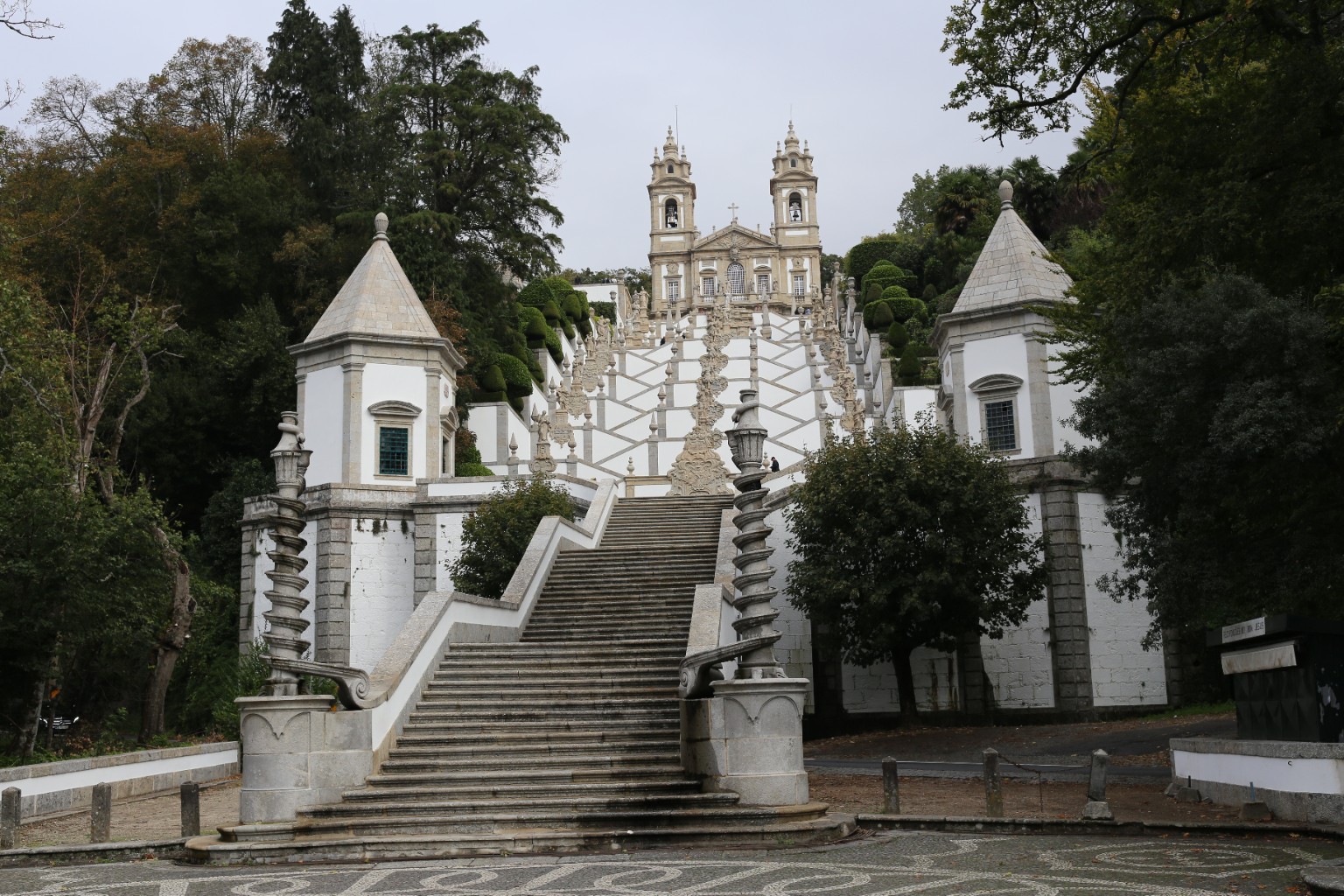
Granite steps and zigzagging white walls climb between chapels, sculpted fountains and clipped trees toward the twin towers of Bom Jesus do Monte in Braga, Portugal.

The photograph catches the sanctuary beneath a pale, overcast sky, with dense woodland closing around its carefully arranged geometry. Across the foreground, patterned stone paving gives way to a broad flight of grey granite steps. Two elaborate stone columns stand on substantial pedestals beside the ascent, their spiralling forms carrying urn-like ornaments above the balustrades. Behind them, small white chapels with pointed stone roofs flank the composition. Their dark, gridded windows and exposed granite borders give the bright walls a pleasing weight. Farther uphill, white parapets cross and recross the slope, making a sequence of zigzags punctuated by sculpted fountains, statues and rounded shrubs. At the summit, the church gathers all those competing lines into a calm, symmetrical finish.

What makes the scene memorable is the tension between the formal design and the vegetation. The clipped trees obey the architecture; the tall woodland around them clearly has other ideas. Dark branches spread across the upper corners of the photograph, while a broad, leafy tree partly conceals the lower wall on the right. There is very little bright colour, and none is needed. White plaster, weathered stone and deep green foliage carry the picture. Even the subdued daylight helps: carvings remain legible, the white walls retain their texture, and the church looks like part of the hillside rather than an object pasted onto a blue sky.

Bom Jesus is a pilgrimage landscape, and the ascent has a religious structure as well as a visual one. Chapels along the route recount the Passion of Christ, while the celebrated Stairway of the Five Senses and the Stairway of the Virtues turn successive stages of the climb into symbolic encounters. The church at the top was built between 1784 and 1811. The ensemble became a UNESCO World Heritage Site in 2019, but the more useful thing to understand before visiting is that the staircase, fountains, planting and woodland belong to the experience as fully as the building at its summit.

For a visit, I would resist making the church the only objective. Pause at the landings, look closely at the carved stonework, and turn around as you ascend. The entrance view is wonderfully theatrical, but a staircase also changes character when seen sideways: walls overlap, individual sculptures emerge, and the grand pattern breaks into smaller compositions. Comfortable shoes make sense here, especially if the stone is wet. Anyone who would prefer to reduce the climbing can consider the sanctuary’s water-powered funicular, checking its current operation before setting out. Walking the whole ascent is one way to experience the place; it need not become a test of determination.

For photography, the obvious central position earns its popularity. In this frame, the broad lower steps create a strong base and the zigzagging parapets keep drawing the eye uphill. Yet the small interruptions matter just as much: an uneven patch of foliage, a dark window, a tiny visitor near the stairway. They give scale to a design that might otherwise feel almost too orderly. Leave enough of the surrounding trees in the frame to show how the sanctuary sits within its landscape. There is a temptation to crop tightly around the famous staircase, but the woodland is doing a good deal of the work.

Braga’s Bom Jesus do Monte rewards the kind of sightseeing that allows a little wandering and a few unnecessary pauses. The church provides the destination, certainly. The approach supplies the anticipation, the changing perspectives and, somewhere along the way, a perfectly respectable excuse to stop and admire another fountain.

Photo credit: VirtualTravelGuide.com.

Filed Under: News

Footer

Recent Posts

  • Bom Jesus do Monte and the Art of the Climb in Braga
  • Quimper, Brittany: A Gothic Cathedral, Medieval Walls and Gardens Full of Color
  • Largo do Chiado at Night: A Brasileira, the Bronze Poet and a Floor Made of Waves
  • Sintra at Noon, Venice at Midnight: Six European Cities and the Hour That Suits Them
  • Porto’s Chestnut Season Is the Shoulder Season Worth Booking
  • Venice at Night Is the Version No Access Fee Covers
  • The 18th-Century Fountain Hidden Inside Bordeaux’s Customs Museum Courtyard
  • The Bilbao Effect, 500 Years Early: Jerónimos Monastery And The Guggenheim
  • Bilbao’s Quiet Renaissance: From Industrial Port to Design Destination
  • Lisbon’s Seven Hills: A Walking Guide That Tells You the Truth

Travel Marketing

  • Travel Marketing
  • Timey.org
  • Ancient Rome
I Own a Small Pension Hotel. Should I Participate in Travel Trade Shows to Promote It?
Where to Find the Perfect Burnt Basque Cheesecake in Spain
One Airline App, Two Carriers: oneworld Tackles the Check-in Gap
Clear Security in Sonoma, Take a Bus Straight to Your SFO Gate
Malta’s Trip.com Partnership Turns Tourism Diversification Into a Distribution Strategy
Royal Caribbean Buys 50% of Sandals Resorts for About $3 Billion, Bringing Cruises and All-Inclusives Together
TOURISE Summit 2027: March 23-25, Riyadh, Saudi Arabia
Wrocław’s Market Square in Fisheye: Why I Kept the Distortion
Salamanca’s Stone Faces: A Photo Essay in Five Frames
Europe’s Tourist Crime Belt: Pickpockets, Bracelet Scams, and Why the Same Offenders Keep Working
Spain’s National Day 2026: A Ceremony of Continuity, a Government Nearing Its End?
Vienna Secession: The Golden Dome That Declared Art's Freedom
Orbital Launch Schedule, Late September and October 2026, With Crew-13 and Starship Flight 14
Martian Moon eXplorer 2026, October 19, Yoshinobu Launch Complex LP-2, Tanegashima
Why Lisbon Left the Carmo Convent Roofless
Plum Tart Is Coming, and These Are the Plums Going Into It
Gauguin's Arearea: The Red Dog Paris Mocked in 1893 and the Painting He Bought Back
Bandinelli's Hercules and Cacus: It Looks Like a Forced Sexual Act Prelude
The Fencer of Wroclaw: A 1904 Fountain That Outlived the City That Commissioned It
Wawel Hill in Kraków: The Castle, the Bronze Model, and the Churches Drawn on the Grass
Caligula: What the Sources Say About the Mad Emperor, and What They Invented
Piranesi's Altar to Apollo and the 18th-Century Business of Selling Ancient Rome
Juno Moneta: How a Roman Goddess Gave Us the Words Money and Mint
Julius Caesar's 44 BCE Denarius: The Coin That Helped Get Him Killed
Half of This Roman Mosaic Glass Bowl Is Plaster, and the Smithsonian Kept It
George Loring Brown's Temple of Peace Painting and the Roman Forum's Most Misnamed Ruin
The Boscoreale Bedroom at the Met May Be Named for the Wrong Roman
The Badminton Sarcophagus Was Carved While the Roman Empire Was Coming Apart
A Freed Slave in Augustan Rome Paid to Have His Wrinkles Carved in Marble
The Met's Caracalla Denarius Promised Imperial Heirs and Then Rome Erased the Bride

Media Partners

  • Travel Market
  • Travel Magazine
Seabourn Expands Earth and Ocean Into a Fleetwide Culinary Philosophy
IMTM 2027, February 16–17, EXPO Tel Aviv
Spain Continues Its Fight Against Tourism With 10% VAT on Holiday Rentals From December 1
American Museum of Natural History: $37 for Out-of-State Adults and a $465 Million Gilder Center
EU Entry/Exit System Is Live at Every Border, and ETIAS Is Delayed Again With No Date
Hofbräuhaus Munich Pours a Litre for €11.60, About €4 Less Than an Oktoberfest Mass
Hundertwasserhaus Vienna: Free to Look At, Closed to Visitors, With a Paid Museum Five Minutes Away
Les Halles de Bacalan: Bordeaux's Food Hall Next to the Cité du Vin, With About 20 Stalls and No Mondays
Les Machines de l'île Nantes: €12 to Ride a 48-Tonne Elephant, With Rides Paused From November
The Met Charges Visitors $30, While New York State Residents Still Pay What They Wish
Taormina, Sicily: A Fountain, a Crowd and the Art of Enjoying a Piazza
Belém, Where Lisbon Keeps Its Seafaring Memories
Syracuse Cathedral: A Greek Temple Behind a Baroque Facade
Vienna's Maria Theresa Square and the Art of Imperial Grandeur
Dolma in Baku: What to Order, How It's Served and Why UNESCO Lists It
Belém Tower Reopened in 2026: Timed Slots, a €15 Ticket and Whether to Go Inside
Big Buddha Temple on Koh Samui: The Naga Staircase, the Dress Code and When to Go
Burgos Cathedral: El Cid's Tomb, the Papamoscas and Free Tuesday Mornings
Caesarea Maritima: Herod's Harbour City, the Ticket and the Free Aqueduct Beach
Catania's Piazza del Duomo: The Lava Elephant, Sant'Agata and the Fish Market Next Door

Copyright © 2022 VirtualTravelGuide.com

Market Analysis & Market Research