Walk down Rue Kéréon from Saint-Corentin Cathedral in Quimper and the scale of the city gradually changes. The cathedral towers give way to shopfronts, narrow houses and, eventually, a small river that seems almost hidden among the buildings. This is the Steïr, a tributary of the Odet, and one of the most interesting parts of the historic centre of Quimper in the Finistère department of Brittany.
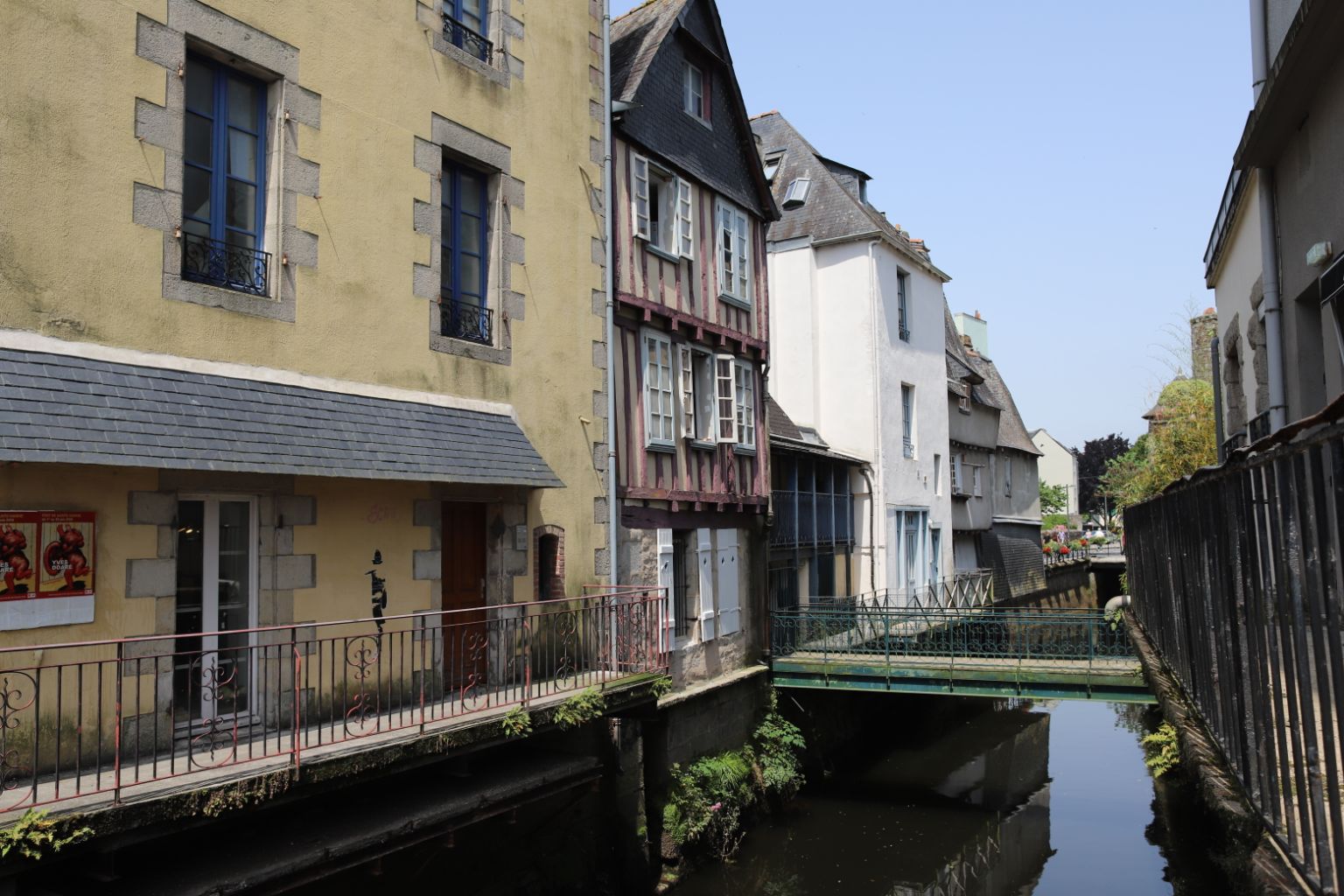
In the photograph, a pale yellow house with deep blue window frames and substantial granite surrounds occupies the left side. Immediately next to it stands a narrow half-timbered building, its faded reddish beams contrasting with white window frames and a steep, slate-covered gable. A modest green iron footbridge crosses the dark water, while delicate metal railings follow the banks and small ferns emerge from the damp stonework. The sun catches the upper façades, leaving the river in almost complete shadow. It is a lovely piece of urban scenery, especially because there is nothing monumental about it.
There is a historical reason to pay attention to this rather narrow stretch of water. In medieval Quimper the Steïr separated the fortified episcopal town, governed by the bishop, from the district associated with the Dukes of Brittany on the western bank. The name Terre au Duc survives in the square across the river. Nearby Rue de la Herse recalls a former fortified gateway, equipped in medieval times with a drawbridge and portcullises. Today, crossing between the two quarters takes a few moments; centuries ago the division carried real political and administrative significance.
Quimper has preserved dozens of timber-framed houses, dating from the sixteenth century through the nineteenth. Look carefully at the different façades along Rue Kéréon and around Place Terre au Duc. Timber, plaster and granite sit side by side, sometimes within a single building. A major fire in 1762 destroyed many wooden houses along Rue Kéréon, and the subsequent preference for stone construction helps explain some of the architectural variety visible today. The old town is the product of successive generations of rebuilding.
For a pleasant walk, start at Place Saint-Corentin, follow pedestrianised Rue Kéréon towards Pont Médard and explore Rue de la Herse and Place Terre au Duc. Allow an extra half hour to wander the surrounding streets and look back at the river from different viewpoints. Continue towards the Odet afterwards, where the river opens out and the urban landscape feels quite different. No admission ticket is needed for this part of Quimper, and it fits easily into a day spent exploring the city on foot.
There are two particularly worthwhile additions to the walk: Saint-Corentin Cathedral, the medieval walls and the Jardin de la Retraite, and the Musée des Beaux-Arts de Quimper, with its collections of Breton and European painting. Check museum opening arrangements before travelling. Leave some unplanned time for a crêperie or café in the old streets, too.
For photography, the Steïr is worth revisiting at different hours. On a bright day the narrow gap between the houses produces strong contrasts, as in this picture; under Brittany’s familiar grey skies, the weathered timber and stone become easier to photograph in softer light. A little rain can bring out the colours of the façades and reflections in the water. There is no need to rush this walk. Some of Quimper’s most memorable views are tucked away just a few steps from its busiest streets.