Venice is famous for its canals, palaces and spectacular waterfront views, but some of its most revealing moments happen in the spaces between the landmarks. Just a short walk from the Rialto Bridge, Campo San Bartolomeo offers a different portrait of the city: a busy little square where people meet, linger, check their phones, browse illuminated shop windows and settle into the rhythm of an ordinary evening.
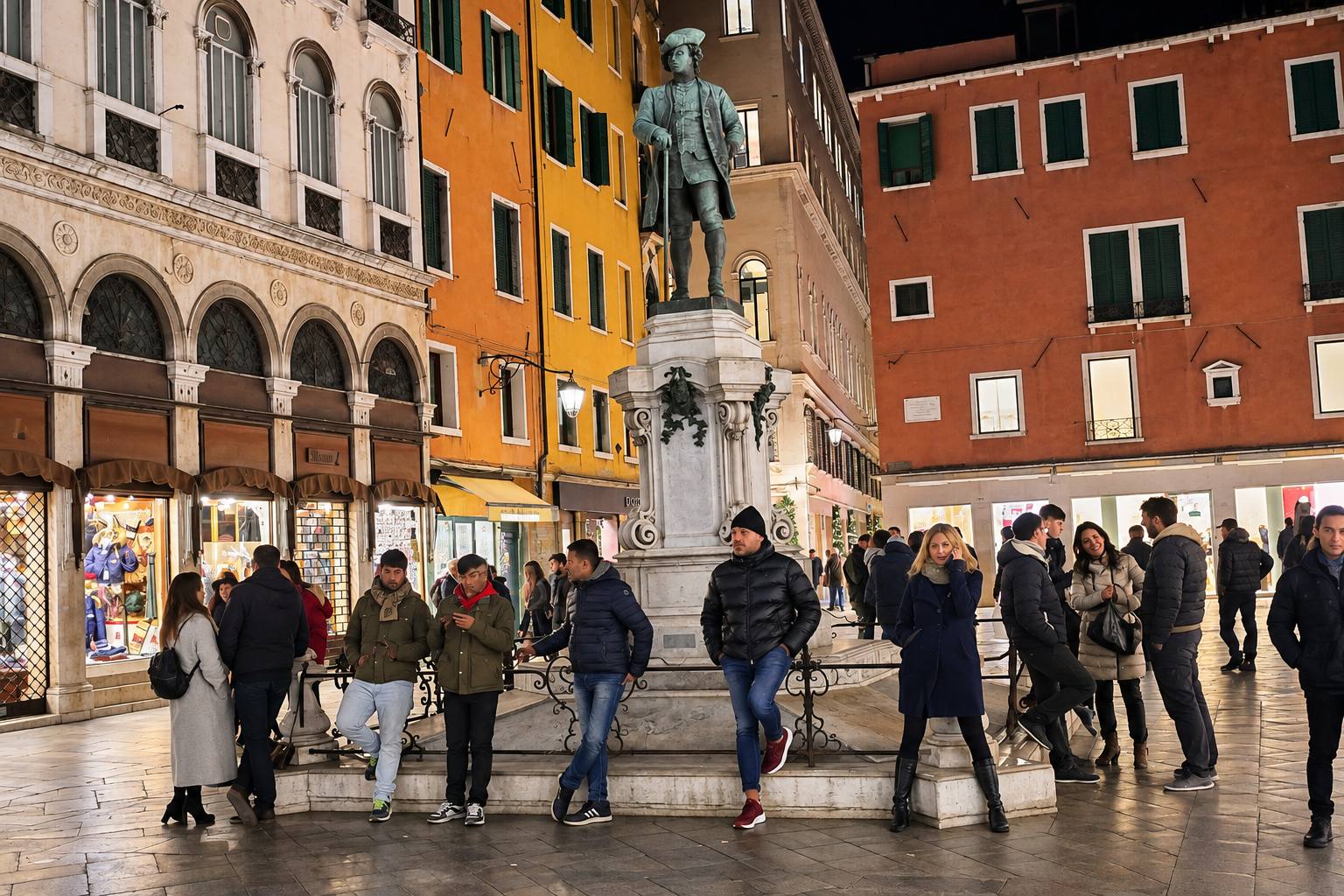
The photograph captures the square after dark, when its buildings and people share the spotlight. At the center rises a bronze figure in eighteenth-century dress, standing on an elaborate pale stone pedestal. Around the monument, visitors lean against the low enclosure, exchange a few words, or pause before heading down another narrow Venetian street. A woman in a dark coat stands near the stonework, a small group gathers beside the railings, and others drift past the bright shopfronts. The paving picks up reflections from the storefront lighting, while the upper floors of the old buildings retreat into the night.
The man above this lively scene is Carlo Goldoni (1707–1793), the Venetian playwright whose comedies helped transform Italian theater by bringing recognizable personalities and everyday human behavior onto the stage. His monument, created by sculptor Antonio Dal Zotto and unveiled in 1883, is a fitting centerpiece for a square that feels like a performance without a script. There are entrances and exits in every direction, conversations overlap, and the cast keeps changing. Goldoni, perhaps, would have appreciated the spectacle.
Locally also called Campo San Bortolomio, the square sits in the San Marco district on the approach to Rialto. Its position makes it one of Venice’s natural meeting points rather than a secluded discovery. Yet that is precisely its appeal. The ochre and terracotta facades, green shutters, arched windows, decorative stonework and ground-floor shops form a distinctive urban setting, while the statue gives the eye a place to rest amid the movement.
Visitors often hurry through this area on their way between the Rialto Bridge and Piazza San Marco. It is worth doing the opposite for a few minutes. Step aside from the main pedestrian flow, look at the ornamental details of the monument, and then let the square reveal itself. The architectural beauty is obvious, but the more interesting experience is watching how a centuries-old public space continues to function as part of modern city life.
For photography, evening is particularly rewarding. Shop windows illuminate faces and stone at street level, while the darker upper facades add depth. A wider composition can include both the Goldoni monument and the people gathered around it, telling a more complete story than a tightly cropped statue photograph. The square is rarely empty, and it does not need to be. The people are part of the picture.
Campo San Bartolomeo is easy to visit on foot from the Rialto Bridge. There is no ticket, no fixed visiting time and no need for an elaborate itinerary. Come through during the day if you want to examine its architecture, then pass through again after sunset to see another side of the same place. In a city that can sometimes feel like an open-air museum, this little square is a useful reminder that Venice remains a living city.