There is a particular pleasure in arriving at a French café without a plan. You find a small table, pull out a chair, order something simple and settle in. No monument to reach before closing time, no museum reservation, no need to check the map every few minutes. The street becomes the attraction. People come and go, chairs scrape against the pavement, glasses meet tables, and a conversation at the next table briefly rises above the general murmur before disappearing into it again.
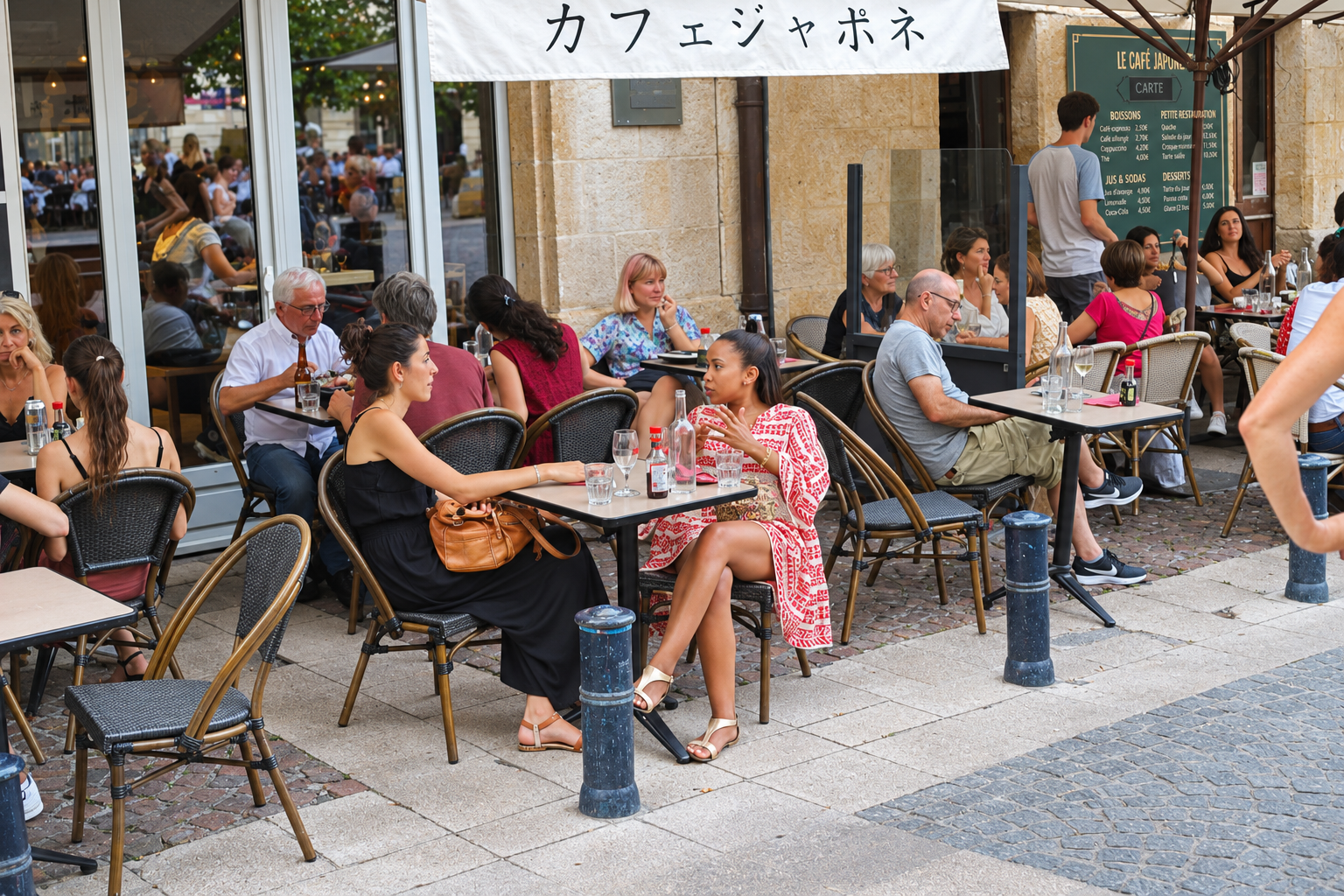
This crowded terrace makes a good case for that kind of afternoon. Two women in the foreground are deep in conversation, one leaning forward in black, the other gesturing in a striking red-and-white dress. Behind them, an older man studies his table, another guest watches the scene from a distance, and groups of friends lean toward one another over drinks. The café is packed, but everyone seems to inhabit a separate little world. Even the Japanese lettering on the white awning, above a French menu, feels perfectly at home in the mixture.
Tourists often treat cafés as practical stops between the places they really came to see. Coffee in the morning, a quick lunch, perhaps a glass of wine before the next attraction. But the café terrace is itself one of the most revealing places in a city. Sit long enough and you begin to notice the rhythm of the neighborhood: regular customers who hardly need to look at the menu, a couple talking seriously, friends meeting unexpectedly, people alone who seem quite content to remain alone. It is everyday life on public display, and somehow it rarely feels like a performance.
There is also something distinctly freeing about a table that asks nothing of you. At home, sitting for an hour without a purpose can feel like wasted time. On a trip, we sometimes make that feeling worse by packing each day with sights, photographs and recommendations. Yet some of the moments that stay with us longest happen when the schedule falls away. A waiter passes. Someone laughs. The light shifts across the pavement. A conversation that began with a casual question keeps going. An ordinary afternoon turns into the part of the journey you remember.
Of course, doing nothing at a café is rarely doing nothing in the literal sense. People are thinking, listening, meeting, arguing, flirting, reading, watching. The point is that none of it needs to produce a result. You do not have to be accomplishing something to justify your place at the table. And in a city that offers a thousand things to do, that can be a surprisingly satisfying choice.
The next time you are exploring a French town, leave a little empty space in the itinerary. Choose a terrace where the chairs face the street, order what you like and give yourself permission to stay. You may return with fewer photographs of landmarks, but with a much better sense of the place. Sometimes the city comes to you.