The train journey from Palermo to Cefalù is more than a convenient way to reach one of Sicily’s most beautiful coastal towns. It is a moving panorama of everyday Sicilian life, where densely populated neighborhoods, old church towers, fishing boats, and stretches of the Tyrrhenian Sea appear and disappear beyond the carriage windows.
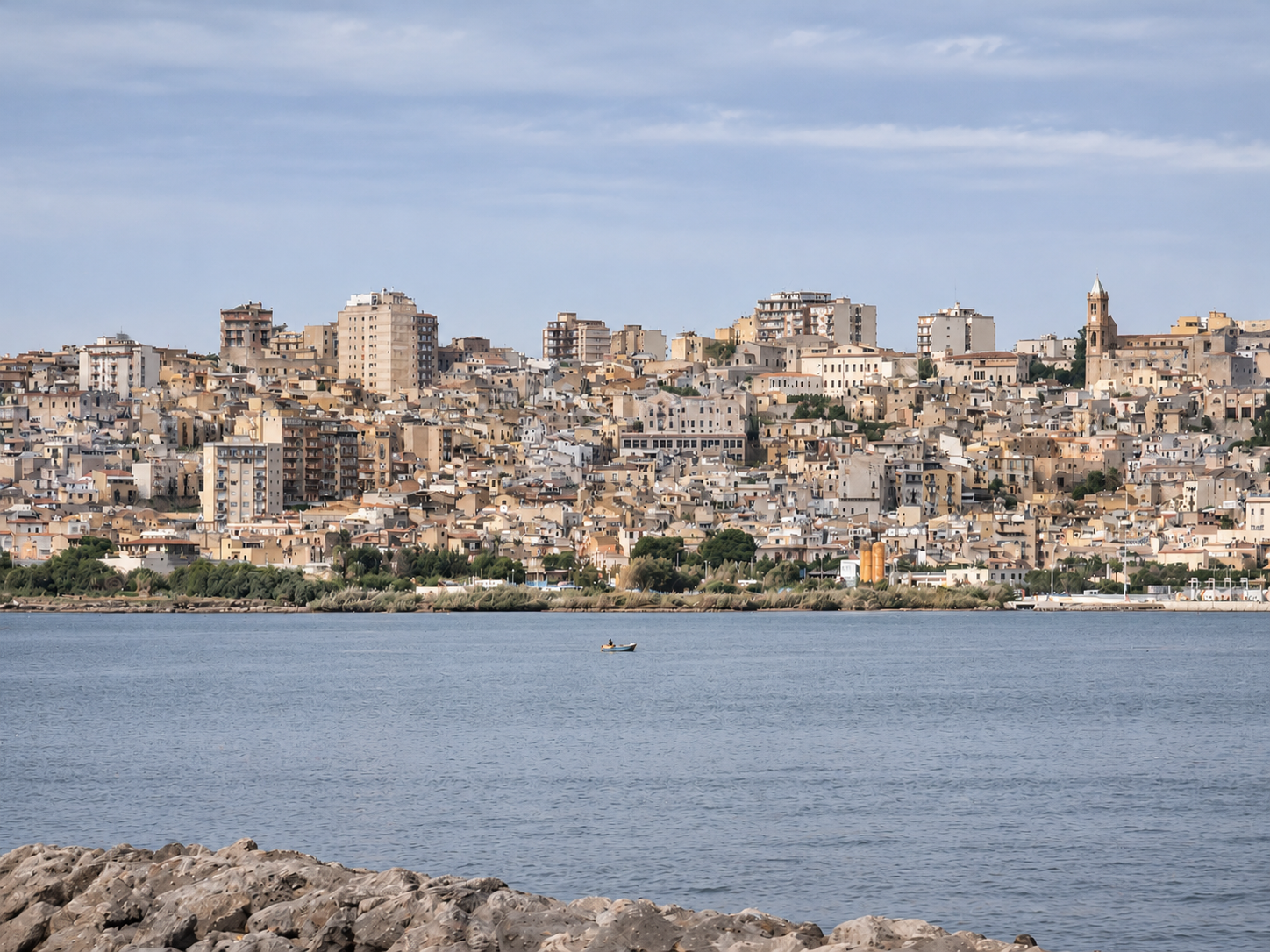
One particularly interesting section passes through the Bagheria area, east of Palermo. Here, the landscape becomes a fascinating mixture of urban density and coastal scenery, with buildings climbing across the hills and the sea providing a surprisingly peaceful foreground.
The photograph, taken during a November 2026 train journey from Palermo to Cefalù, captures this contrast. Across a broad expanse of calm water, hundreds of pale buildings form a tightly packed urban landscape. Modern apartment towers rise above smaller houses, while a slender church bell tower provides a distinctive vertical landmark. A tiny boat in the foreground gives the scene its sense of scale.
Bagheria is often overlooked by visitors heading directly to Cefalù. Yet the town has a remarkable architectural history. During the seventeenth and eighteenth centuries, wealthy Palermo families built elaborate country residences here, transforming the surrounding countryside into an aristocratic retreat.
Among the most famous is Villa Palagonia, celebrated for its extraordinary collection of grotesque stone figures and eccentric Baroque architecture. Villa Cattolica, another historic residence, houses the Museo Guttuso, dedicated to the Sicilian painter Renato Guttuso, who was born in Bagheria.
The nearby coastal communities of Aspra, Santa Flavia, and Porticello offer another side of the region. Fishing remains an important part of their identity, and their waterfronts retain a character quite different from the heavily visited historic center of Palermo.
What makes the railway journey especially rewarding is the absence of a carefully staged tourist experience. The passenger sees ordinary Sicily: apartment blocks beside centuries-old churches, industrial structures close to small harbors, and densely built neighborhoods opening unexpectedly toward the sea.
November adds a different atmosphere. The light is softer, the colors more restrained, and the coastal landscape feels less theatrical than it does during the bright summer months. The muted blues of the water and sky complement the limestone, cream, and faded ochre of the buildings.
Photographing through a moving train window is not always easy. Reflections, dirty glass, and the speed of the train can interfere with the view. Yet the resulting photographs sometimes capture something more spontaneous than a carefully composed image from a conventional viewpoint.
For travelers taking the Palermo–Cefalù train, the best advice is simple: choose a window seat, keep the camera ready, and pay attention to the landscape before reaching the famous destination. Bagheria and its neighboring coastal communities deserve more than a passing glance.
Sometimes the most memorable part of a journey is the place you never intended to visit.