Mont Saint-Michel is one of France’s most extraordinary historic landmarks, a place where medieval architecture, religious history and the natural forces of the sea come together. Seen from the broad tidal flats of Normandy, its abbey appears to rise straight out of the sand, crowned by a slender spire against the immense sky.
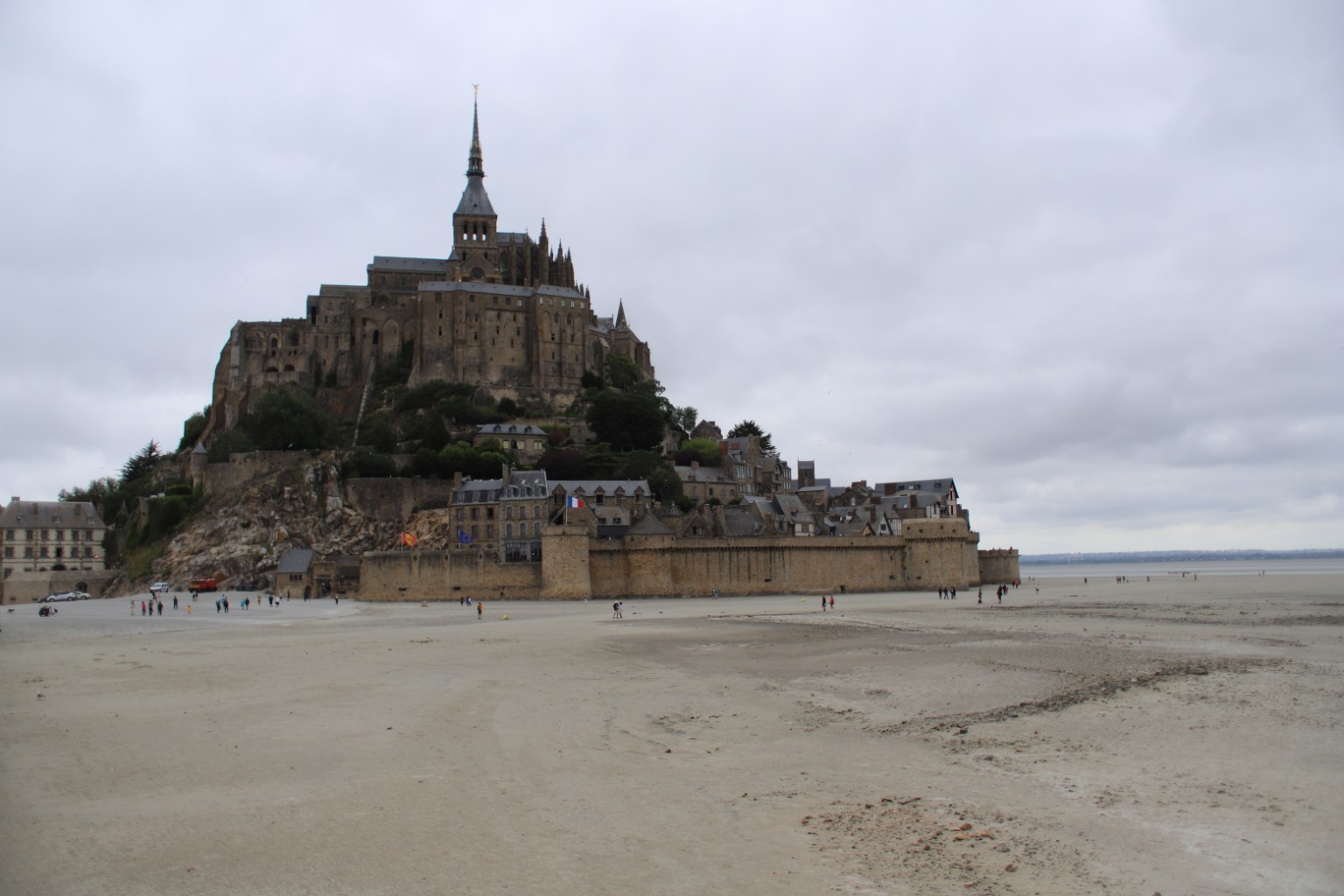
The photograph captures the entire island rather than just its famous abbey. The stone ramparts stretch across the lower slopes, tightly packed houses occupy the space beneath the monastery, and a handful of visitors crossing the exposed bay reveal the astonishing scale of the monument. On this overcast day, the subdued light gives the medieval stonework an almost austere appearance.
The site’s religious history goes back to the eighth century, when a sanctuary was established on the rocky mount. A Benedictine community settled here in the tenth century, and the abbey grew over subsequent centuries into a major pilgrimage destination. Its architecture reflects successive phases of medieval construction, with monumental masonry, Gothic details, steep roofs and an extraordinary arrangement of buildings adapted to the island’s narrow summit.
From a distance, the structure seems to form a single stone pyramid, but the different levels tell a more complicated story. The fortified village occupies the base, while religious buildings dominate the summit. The walls and towers speak to the mount’s defensive history, and the slender spire provides the final vertical accent.
Equally important is the landscape around it. Mont Saint-Michel stands in a bay known for dramatic tides. At low tide, enormous expanses of sand and mud are exposed, transforming the view into something resembling a vast open plain. As the tide returns, water changes the island’s appearance again. This changing setting is a fundamental part of the experience, not simply a scenic backdrop.
The photograph’s broad foreground is especially revealing. Tiny figures are scattered across the pale sand, tracks and darker patches interrupt its surface, and the horizon stretches into the distance on the right. The French flags near the lower buildings provide a small burst of color. The cloudy sky makes the abbey’s silhouette all the more pronounced.
Visitors should be cautious about exploring the tidal flats independently. Fast-changing tides, channels and hazardous patches of sediment can make unguided crossings dangerous. A guided bay walk is a better option for anyone wishing to experience the surrounding landscape on foot.
Mont Saint-Michel and its bay have been inscribed on the UNESCO World Heritage List since 1979. The mount remains a living religious site as well as a celebrated destination for travelers, historians and photographers. Its real magic lies in the way the abbey, village, rock and sea are inseparable: each gives the others their extraordinary character.