Palermo does not always announce its most interesting places with grand architecture or crowds of visitors. Some of its richest stories unfold in modest squares where apartment balconies overlook cafés and ancient stonework shares space with the routines of an ordinary neighborhood. Piazza Rivoluzione, in the historic Kalsa area, is one of those places. At its center stands the Fontana del Genio, a fountain representing the Genius of Palermo, a mysterious civic guardian whose image has long been associated with the city’s identity and its desire for freedom.
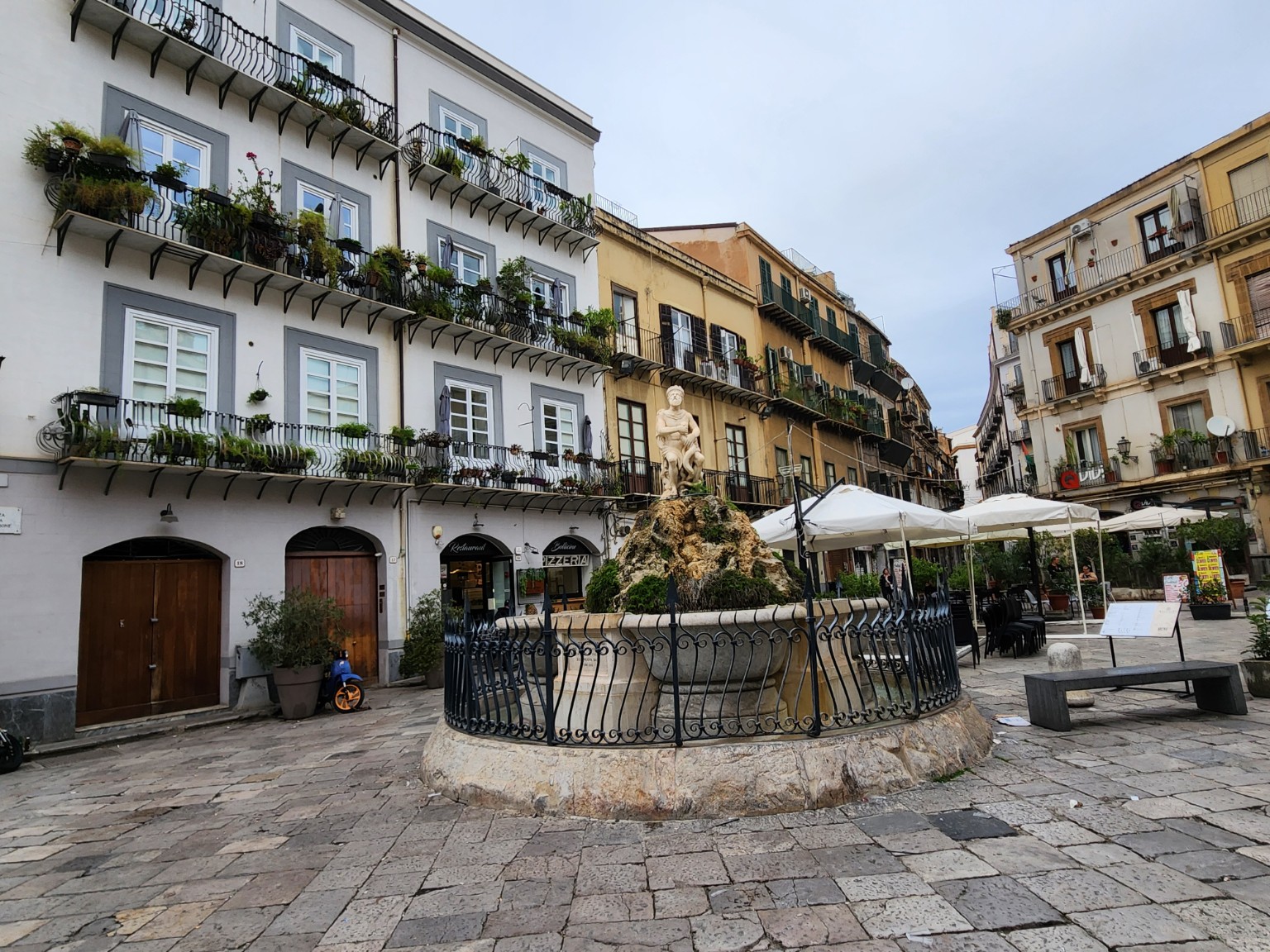
The square makes an immediate impression because it feels lived in rather than staged. The photograph, taken in November 2026, shows an irregular expanse of pale, weathered paving stones surrounding a raised circular fountain. A decorative black iron fence traces its perimeter. Behind the monument, a striking white building has gray-trimmed windows and long wrought-iron balconies almost overflowing with greenery. Plants spill from boxes and pots in several tiers, turning an otherwise restrained façade into a vertical garden. Next door, ochre and sand-colored buildings show the layered textures of an old Mediterranean city. Café tables shelter beneath white umbrellas, and there is enough open space to stop and look without feeling hurried.
The figure atop the fountain is not a saint, king or general. It is the Genio di Palermo, the Genius of Palermo, a symbolic protector of the city whose origins reach into traditions older than many of Palermo’s surviving monuments. The figure is usually portrayed as a mature, crowned and bearded man accompanied by a serpent. The snake feeding at his chest is the most startling detail and one that visitors can easily miss when admiring the square from a distance. The symbolism has attracted different interpretations over time, often connected with the city’s capacity to nourish, protect and renew itself. There is no single simple explanation that exhausts the meaning of this unusual emblem.
Palermo’s Genius appears in several places across the city, making him something of a recurring character in its streetscape. The fountain in Piazza Rivoluzione is commonly called the Genio di Fieravecchia, after the old market area with which it became associated. Unlike the deeply religious devotion surrounding Santa Rosalia, Palermo’s patron saint, the Genius belongs to the city’s civic imagination. The two figures coexist in Palermo’s public culture, revealing how religious tradition and local political identity have developed side by side.
The fountain’s setting is essential to understanding its importance. Fieravecchia was historically a busy commercial quarter, part of a city whose streets were animated by merchants, artisans, port activity and the constant movement of goods. Public squares were not simply decorative spaces. They were places where news circulated, people gathered, arguments erupted and political loyalties became visible. The presence of the Genius here gave the neighborhood a recognizable symbol around which its residents could rally.
In 1848, Sicily rose against Bourbon rule as revolutionary movements swept through much of Europe. Palermo was a major center of the uprising, and the square became associated with the revolutionary cause. The Genius, already an emblem of the city, acquired an especially powerful meaning as a figure of liberty and civic resistance. The monument’s political significance was not merely retrospective: the authorities understood that public symbols could matter. After the revolutionary period, the statue was removed under Bourbon rule. Its return in 1860, during the upheaval that accompanied Giuseppe Garibaldi’s campaign in Sicily, became part of the story of Palermo’s liberation and the end of Bourbon control.
The name Piazza Rivoluzione preserves this memory. A visitor might encounter the fountain while searching for a restaurant or wandering toward the waterfront, without realizing that the quiet space is tied to one of the defining chapters of nineteenth-century Sicilian history. That contrast is part of its appeal. The square does not resemble a formal national memorial. There are no monumental avenues leading toward it. History is embedded in a place where people still live, eat, meet and pass through.
Take a closer look at the sculpture itself. The pale seated figure rises above a rough mound of rock, whose irregular surfaces and greenery give the fountain an almost naturalistic base. The contrast between the carefully carved human form and the rugged stone below is especially effective from the side. The iron fence, with its repeated curves and pointed details, frames the monument without completely separating it from the square. The weathering on the stone is worth noticing too: it speaks to a monument that has survived changing political regimes, urban renovations and generations of everyday use.
The surrounding buildings deserve as much attention as the fountain. Palermo’s old center is famous for its elaborate churches and palaces, but its domestic architecture is equally revealing. In this photograph, narrow balconies form strong horizontal lines across the white façade, while the neighboring buildings offer a patchwork of shutters, balconies, satellite dishes and modest architectural repairs. The plants on the railings soften the geometry of the windows. Nothing here is perfectly symmetrical or pristine, and that is precisely what gives the scene its visual character. It is a city that continues to adapt rather than a preserved architectural exhibit.
The square is also an excellent introduction to the Kalsa neighborhood. Kalsa’s name reflects the Arabic period of Palermo’s history, when the area developed as an important administrative district. Over the centuries it absorbed Norman, medieval, Baroque and modern influences. Today, walking through Kalsa means encountering elegant façades, narrow lanes, small churches, courtyards, art spaces and residential streets in quick succession. Piazza Rivoluzione fits naturally into this mosaic, even if it is less famous than some of the district’s major attractions.
From the square, a leisurely walk can lead toward Piazza Marina, where the Giardino Garibaldi offers an entirely different atmosphere beneath its remarkable old trees. Nearby are the streets around Via Alloro, with historic buildings and cultural landmarks, and farther toward the sea lies the Foro Italico promenade. Another possible direction takes you deeper into the historic center toward the markets and busy commercial streets. Palermo rewards this kind of unstructured exploration: one turn may reveal a richly decorated church doorway, the next a tiny workshop or a neighborhood bar.
Allow time for the square itself instead of treating it as a quick photo stop. Stand back far enough to see the full composition of fountain and buildings, then approach the fence to study the Genius and his serpent. Look at the inscription and the construction of the basin. Walk around the monument, because the backdrop changes significantly with each angle. On one side, the greenery of the white building dominates; on another, the warmer ochre buildings and restaurant terraces place the fountain in a more intimate urban setting.
For photography, a wide-angle lens works particularly well here. The space is compact, but the fountain, surrounding architecture and balconies can all be brought into the frame without losing their relationship to one another. The November photograph demonstrates the advantage of including a generous foreground of old paving stones: the stones lead the eye toward the iron railing and central figure, while the façades provide scale. A closer photograph can isolate the crowned head, serpent and sculptural details. Overcast light, as seen here, is useful because it reduces harsh contrasts between the pale buildings and darker ironwork.
Morning and late afternoon are attractive times to visit, although the precise light depends on the season and the surrounding buildings. An overcast day should not discourage you. In fact, soft light can make Palermo’s pale limestone, faded plaster and painted shutters easier to photograph. If the cafés are open, sitting down for a coffee offers a chance to watch the square gradually change as residents and visitors come and go.
One of the pleasures of visiting Piazza Rivoluzione is its scale. There is no ticket queue and no elaborate route through an attraction. The square is an outdoor public space, and the fountain can be appreciated from the surrounding pavement. Café and restaurant opening hours vary, so visitors should check individual establishments rather than assume the terraces will always be operating. Comfortable shoes are useful for the uneven stone surfaces, both here and throughout Palermo’s older streets.
To find it, search for Piazza Rivoluzione or Fontana del Genio di Palermo in the Kalsa district of central Palermo. It can be incorporated into a walking route through the historic center rather than treated as a separate excursion. If you are exploring Palermo for the first time, pairing this square with Piazza Marina and a walk along Via Alloro provides a rewarding mix of public history, residential architecture and street life.
Palermo’s great monuments tell the stories of rulers, dynasties and religious institutions. Piazza Rivoluzione tells a slightly different story: that of a city imagining itself through a crowned guardian, defending its civic identity, and turning an ordinary gathering place into a symbol of political change. The fountain has witnessed far more dramatic days than the quiet November scene in the photograph. Yet the contrast between past upheaval and present-day calm is exactly what makes this square worth seeking out.
Visit for the Genius, stay for the balconies, the stone paving and the unhurried atmosphere. Piazza Rivoluzione may not be the most spectacular sight in Palermo, but it is one of those places that helps explain why the city remains so compelling long after its famous churches and palaces have been photographed.