New York City has no shortage of spectacular museum interiors, but few offer the quiet elegance of the Garden Court at the Frick Collection. Hidden inside a former private mansion on Manhattan’s Upper East Side, this remarkable indoor courtyard combines classical architecture, sculpture, tropical greenery, and the gentle sound of flowing water. It is one of those rare museum spaces where the building itself becomes as memorable as the artworks displayed around it.
The Frick Collection is best known for its extraordinary holdings of European paintings, sculptures, and decorative arts, assembled by industrialist Henry Clay Frick. Visitors come to admire masterpieces by Rembrandt, Vermeer, Bellini, Fragonard, and other great artists. Yet the Garden Court offers something different: an architectural experience almost detached from the relentless pace of New York outside.
From Private Mansion to Public Museum
The Frick mansion was designed by Carrère and Hastings and completed in 1914 as the New York residence of Henry Clay Frick and his family. Unlike many museums built specifically to accommodate large public collections, the Frick retains much of the intimate atmosphere of a wealthy collector’s home. Its galleries, furnished rooms, and carefully proportioned interiors reflect an era when art collecting, architecture, and domestic life were closely intertwined.
Following Frick’s death in 1919 and his wife’s death in 1931, the mansion was adapted for public use. Architect John Russell Pope designed the museum’s expansion, including the Garden Court, transforming an earlier open courtyard area into an enclosed architectural centerpiece. The museum opened to the public in 1935.
The result is a fascinating meeting of residential architecture and institutional grandeur. The Garden Court is neither a conventional gallery nor simply a passage between exhibition rooms. It is a place designed to be experienced in its own right.
A Classical Garden Beneath a Glass Roof
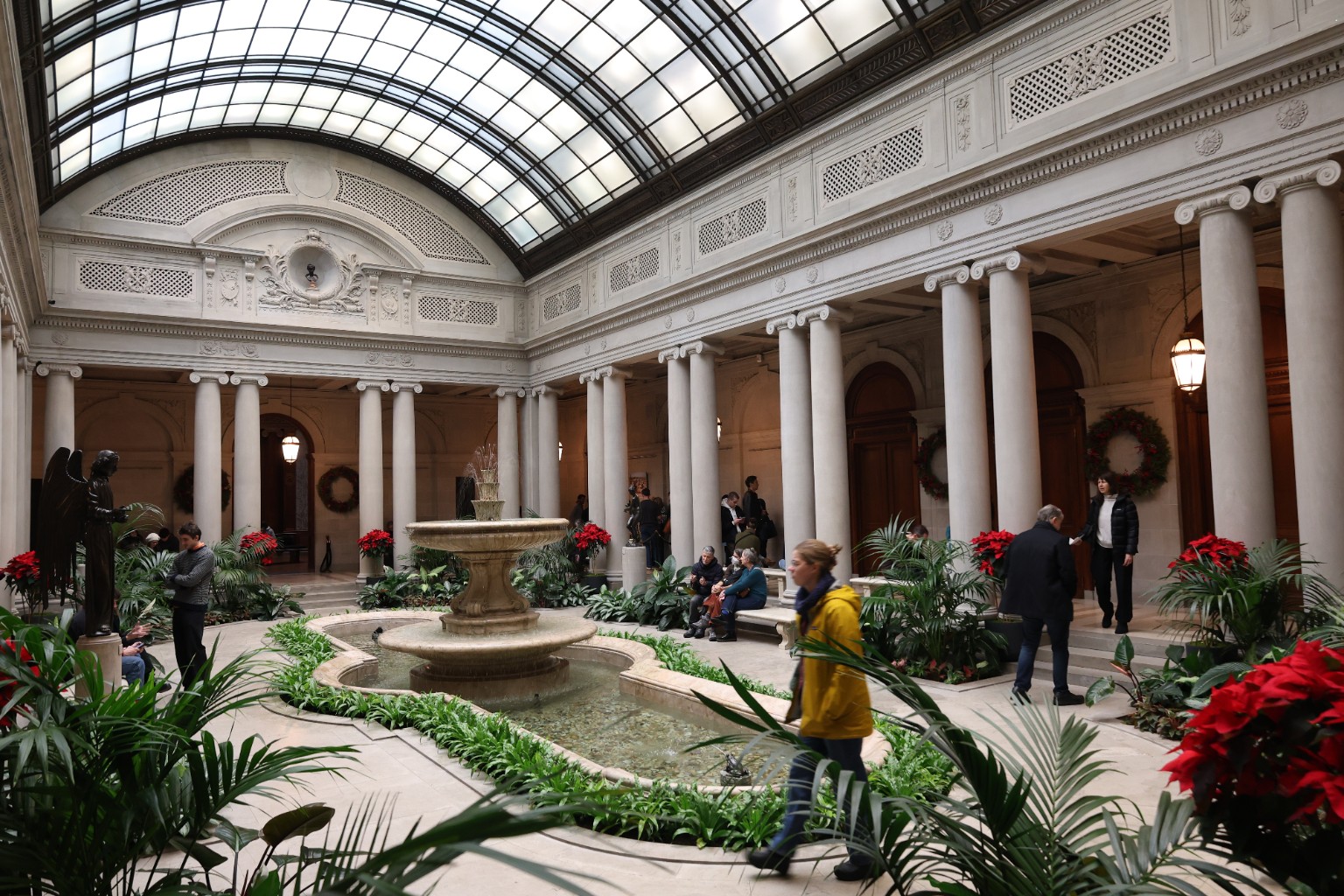
The most striking feature is the enormous curved glass ceiling, supported by a dark metal framework. The roof allows daylight to enter from above, illuminating the pale architectural surfaces without exposing the interior to the weather. On an overcast day, the light becomes especially soft and even, bringing out the fine details of the classical decoration.
Tall Ionic columns line the courtyard, supporting an elaborate entablature decorated with ornamental panels, delicate reliefs, and latticework. The combination evokes an Italian Renaissance palace, although the architectural language also reflects the American Beaux-Arts tradition of the early twentieth century.
At the center stands a tiered stone fountain, surrounded by a shallow reflecting pool and carefully maintained planting beds. Water, stone, greenery, and light are arranged in a composition that feels formal without becoming rigid. The fountain provides a natural focal point, while surrounding paths invite visitors to walk slowly around the space or sit and enjoy the atmosphere.
Bronze sculptures add another dimension to the courtyard. Their dark surfaces contrast with the pale stone and white columns, giving the otherwise restrained composition a sense of depth and drama.
A Winter Visit to the Garden Court
The accompanying photograph captures the Garden Court during the holiday season, when its classical architecture is complemented by Christmas decorations. Large wreaths hang against the walls, while brilliant red poinsettias appear among the palms and other tropical plants.
The seasonal decorations create a particularly appealing contrast. The architecture is formal, symmetrical, and almost monochromatic, while the plants introduce irregular shapes and vivid colors. The red flowers draw the eye across the courtyard, connecting the central fountain with the surrounding colonnades.
The photograph also reveals something important about how this space functions. Visitors are not simply moving through it on their way to another gallery. Some sit beside the fountain, others pause to admire the architecture, and a few linger near the sculptures. The Garden Court encourages precisely this kind of unhurried experience.
There is a distinctly European quality to the setting, reminiscent of covered courtyards in historic Italian palaces or nineteenth-century conservatories. Yet it also belongs unmistakably to New York’s Gilded Age architectural heritage, when wealthy patrons commissioned residences inspired by the great houses of Europe.
Why the Garden Court Matters
One of the pleasures of visiting the Frick Collection is the contrast between its relatively intimate galleries and the openness of the Garden Court. The museum’s paintings are often encountered in rooms that retain a residential character, complete with antique furniture, fireplaces, and decorative objects. The courtyard, by comparison, opens dramatically upward toward the sky.
This change of scale offers visitors a visual and psychological pause between encounters with works of art. Rather than competing with the paintings, the architecture creates a different kind of aesthetic experience.
The courtyard also demonstrates how successful museum design can be without relying on architectural spectacle alone. Its materials, proportions, and decorative details are traditional, but the space remains exceptionally effective. The fountain provides movement and sound, the roof introduces changing daylight, and the planting softens the geometry of the surrounding stonework.
Following an extensive renovation and modernization, the Frick Collection reopened its historic Fifth Avenue home in April 2025. The restoration renewed attention to the building’s architecture and the relationship between its historic interiors and the art collection.
Visiting the Frick Collection in Manhattan
The Frick Collection is located at 1 East 70th Street, at Fifth Avenue, directly across from Central Park. Its position makes it a natural destination for visitors exploring the Upper East Side, particularly those interested in art, architecture, and New York’s historic mansions.
Unlike the enormous Metropolitan Museum of Art farther north, the Frick offers a more concentrated museum experience. Its appeal lies partly in the exceptional quality of its collection and partly in the opportunity to see major European artworks in surroundings that preserve the character of a private residence.
Allow enough time to appreciate the building itself, not just the paintings. The Garden Court deserves a leisurely visit, preferably with a few minutes spent sitting beside the fountain and looking upward at the glass roof.
Photography rules and visitor arrangements can change, so it is worth checking the museum’s official website before arriving.
The Garden Court is a reminder that some of New York’s finest architectural experiences are found behind relatively discreet entrances. Outside, Fifth Avenue is busy with traffic and pedestrians. Inside, beneath the great glass vault, the atmosphere changes completely. It is a small architectural escape in the middle of Manhattan, and one of the most memorable spaces in the Frick Collection.
Visitor information: The Frick Collection. Address: 1 East 70th Street, New York, NY 10021, United States.