Palermo Cathedral is one of Sicily’s most compelling demonstrations of how Islamic artistic traditions continued to shape architecture under Christian rule. Its eastern apses, photographed here at night in black and white, are particularly rich in geometric ornament, patterned stonework, pointed arches and repeating decorative motifs.
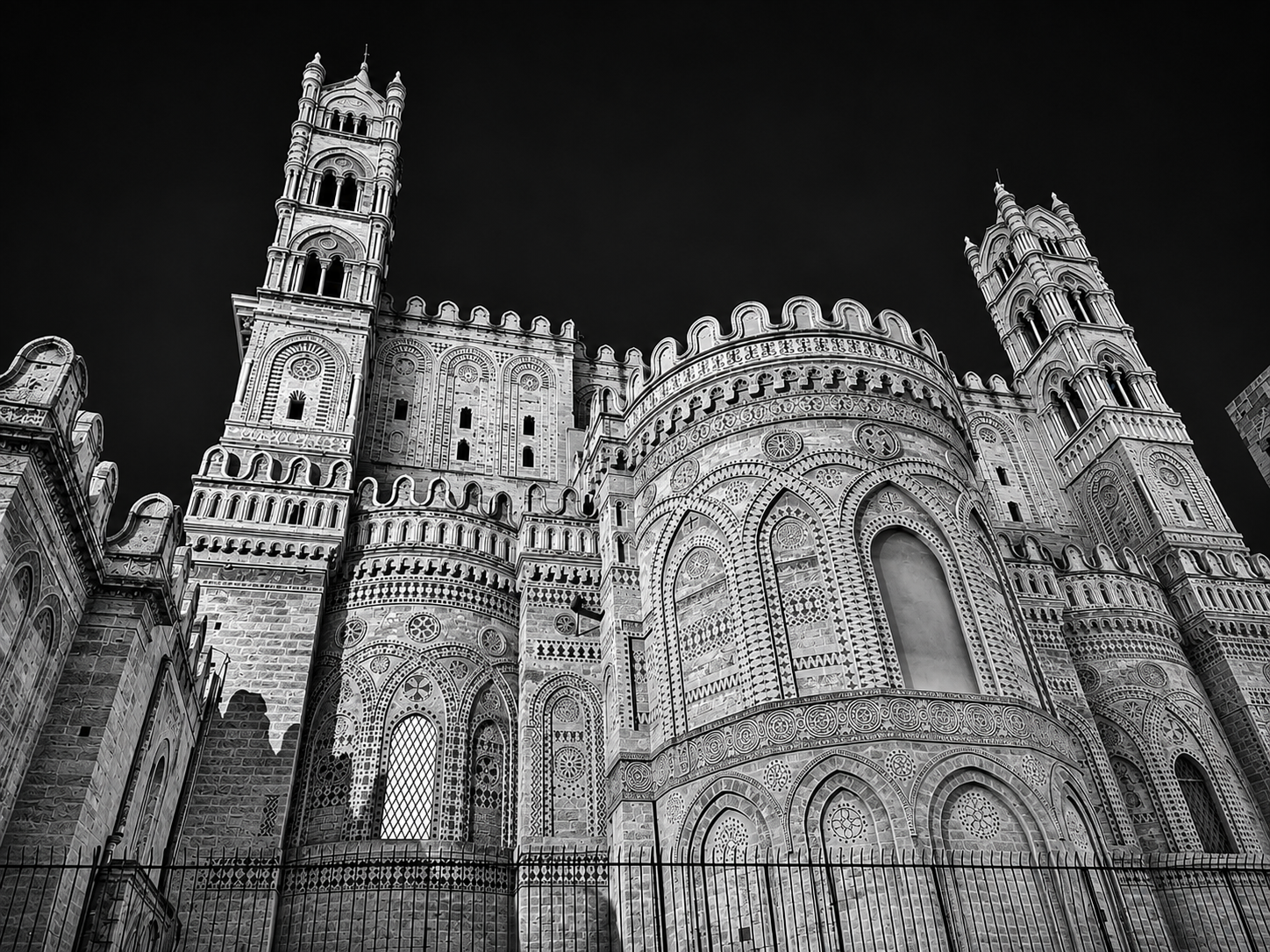
The rounded central apse dominates the view. Its masonry is organized into horizontal ornamental bands, circular medallions and tall interlacing arch motifs. The adjoining apses repeat these patterns on a smaller scale, while the towers rise above a dense composition of decorative stonework. Removing the golden color of nighttime illumination reveals something easy to overlook: the remarkable precision and rhythm of the architectural design.
These features belong to Sicily’s Arab-Norman architectural tradition, a distinctive synthesis of Islamic, Byzantine and Western European artistic languages. Palermo had been an important Muslim-ruled Mediterranean city before the Norman conquest in 1072. Under Norman rule, craftsmen and artistic conventions associated with earlier Islamic Sicily remained influential. The result was not an imitation of a single style but a new architectural language born of cultural exchange.
The present cathedral was begun in 1185 under Archbishop Walter Ophamil. Its original medieval fabric and later additions reflect centuries of changing tastes, yet the eastern exterior remains an especially vivid witness to the city’s multicultural medieval past. Contrasting pale limestone and darker stone, including lava-stone inlays, once gave many of these geometric designs a polychrome effect that is different from the monochrome impression of this photograph.
The site itself carries an even older layered history. A church here was converted into a mosque during Islamic rule, and Christian worship returned after the Norman conquest. An Arabic inscription associated with the Quran survives on a column near the southern portico, another reminder that the cathedral’s history cannot be reduced to one religion or architectural tradition.
Palermo Cathedral is part of the UNESCO World Heritage property Arab-Norman Palermo and the Cathedral Churches of Cefalù and Monreale, inscribed in 2015. The designation recognizes the exceptional interchange of Western, Islamic and Byzantine cultures in medieval Sicily.
For visitors, the eastern side is worth examining slowly rather than treating the cathedral only as a grand landmark. Look for the circular motifs, repeated pointed arches, patterned stone bands and subtle contrasts in masonry. Return after dark if possible: artificial lighting isolates the ornament against the sky, making this side of Palermo Cathedral feel almost like an enormous piece of geometric sculpture.