High above the historic town of Sintra, Portugal’s Pena Palace looks less like a royal residence and more like an architectural fantasy brought to life. Its yellow towers, red walls, gray stone fortifications, elaborate gateways and unexpected mixture of architectural styles create one of Europe’s most recognizable palaces. Yet photographs of its famous colorful façades tell only part of the story. The real fascination begins when you walk around the building and discover how its terraces, stairways, towers and seemingly medieval defenses fit together on a steep, rocky hillside.
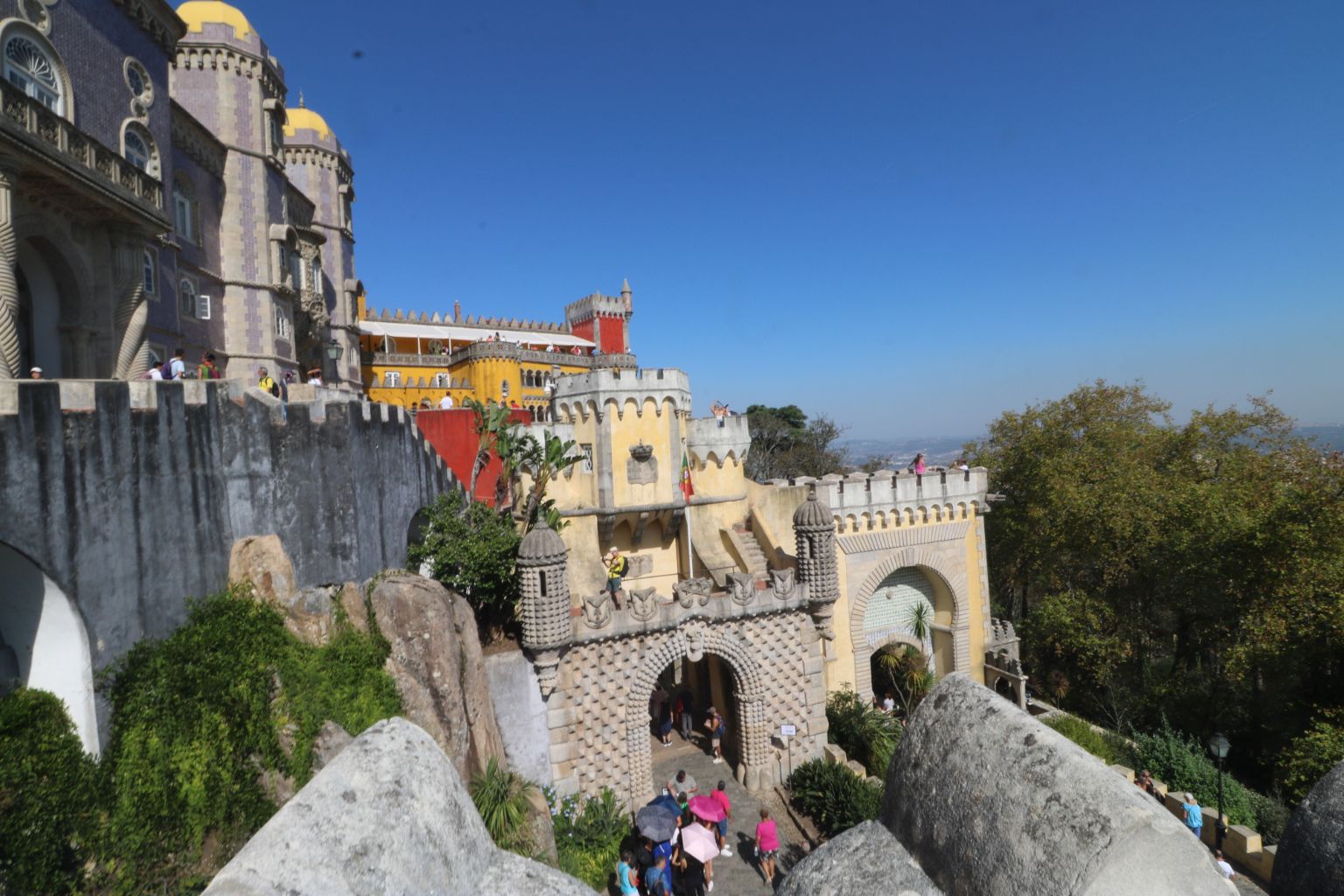
The photograph captures a particularly interesting perspective of the palace. On the left, massive gray towers rise above a weathered defensive-looking wall, their surfaces interrupted by narrow windows, ornamental arches and small balconies. Behind them, two cylindrical towers with bright yellow domed roofs stand against a remarkably clear blue sky. Farther along the complex, a vivid yellow façade stretches toward a red crenellated tower, while pale yellow battlements and elaborate stone arches descend toward the gardens.
In the foreground, enormous granite boulders appear almost integrated into the architecture. Visitors move through a richly decorated stone gateway beneath two slender, textured turrets, while others follow the narrow paths and staircases connecting the palace’s different levels. The photograph is especially effective because it reveals the scale of the place through these small human figures. It also shows something that more conventional postcard views tend to conceal: Pena Palace is not a single symmetrical building but a wonderfully irregular collection of structures, courtyards, passages and terraces.
The palace owes much of its extraordinary appearance to King Ferdinand II, who transformed the remains of a former monastery into a Romantic royal retreat during the nineteenth century. The design combines Gothic, Manueline, Moorish and Renaissance influences, sometimes within the same architectural composition. What might seem excessive elsewhere somehow works here, partly because the building was conceived as a Romantic expression of imagination rather than an exercise in historical accuracy.
There is a fascinating comparison to be made with Neuschwanstein Castle in Bavaria. Both palaces are nineteenth-century Romantic creations, built for rulers who preferred an idealized vision of the past to the architectural conventions of their own time. Both occupy dramatic elevated locations surrounded by forests and scenery, and both resemble medieval castles despite being products of a much later age.
The historical connection is cultural rather than a documented act of imitation. King Ferdinand II of Portugal, who transformed Pena, came from the German House of Saxe-Coburg and Gotha; King Ludwig II of Bavaria, who commissioned Neuschwanstein, belonged to the Wittelsbach dynasty. Ferdinand’s project preceded Neuschwanstein, whose construction began in 1869. Their shared taste belongs to the wider Romantic movement, which treated medieval history as material for imaginative reinvention.
Yet the fantasies are quite different. Neuschwanstein offers a comparatively unified image of a knight’s castle, with pale towers, steep roofs and interiors influenced by German legends and Richard Wagner’s operas. Pena is more exuberant and eclectic: medieval battlements mingle with Portuguese Manueline ornament, Moorish-inspired arches, brilliantly colored walls and remnants of a real monastery. Neuschwanstein seems to emerge from a German fairy tale; Pena looks as though several civilizations contributed to the same dream.
The personalities behind the projects add another dimension. Ferdinand was an enthusiastic patron of architecture, art and landscape design, and Pena served as a royal summer retreat. Ludwig imagined Neuschwanstein as an intensely personal refuge, increasingly removed from his public duties. Both kings used architecture to build a world apart from ordinary politics, but Ferdinand’s vision feels more playful and cosmopolitan, while Ludwig’s is more theatrical and inward-looking.
The landscape makes the comparison especially rewarding. Neuschwanstein draws its drama from the steep Bavarian Alpine setting, its pale towers contrasting with dark forests and mountains. Pena responds to Sintra’s granite outcrops, wooded slopes and Atlantic-influenced climate. In this photograph, the enormous boulders, irregular stairs and layered walls reveal how closely Pena is woven into the hillside. It does not merely stand on the hill; in places it seems to grow from it.
Neither building should be mistaken for an authentic medieval fortress. Both reinvented the Middle Ages rather than reconstructing them. Perhaps that is why they remain so captivating: visiting either one means stepping inside a royal imagination, made monumental in stone.
Pena Palace is part of the Cultural Landscape of Sintra, recognized as a UNESCO World Heritage Site. Its setting is as important as its architecture. The surrounding park contains winding paths, exotic trees, hidden viewpoints and gardens that take advantage of Sintra’s distinctive hills and often misty climate. On a clear day, the palace offers expansive views across the wooded landscape toward the Atlantic coast.
Visiting Pena Palace requires more time than simply walking through its royal rooms. The exterior terraces and architectural details deserve careful exploration, and the steep terrain makes comfortable footwear essential. Timed entry arrangements should be checked in advance, particularly during busy tourist periods. Visitors arriving from Lisbon can reach Sintra by train and continue toward the palace using local transport, although the final approach is uphill.
Perhaps the most memorable quality of Pena Palace is its refusal to behave like an ordinary European castle. One moment you are looking at something resembling a medieval fortress; the next, an almost theatrical yellow tower appears above a red wall. Then a Moorish-inspired arch or a strange ornamental turret changes the impression again. It is a place where architectural contradictions become the attraction, and where every turn seems to produce another unexpected composition.
For photographers, that makes Pena Palace particularly rewarding. Wide-angle views can capture the relationships between its many architectural layers, while tighter compositions isolate the decorative details, contrasting colors and dramatic geometry. Including visitors, as in this photograph, gives the otherwise fantastical structures a human scale. And sometimes the most interesting view is not the famous frontal panorama but a side passage where architecture, rock, vegetation and people all compete for attention.