Cefalù is best known for its Norman cathedral, old fishing harbour and long beach. Yet a walk through this Sicilian town also reveals a more intimate history: monuments to the people who left their communities to fight in the First World War and never returned.
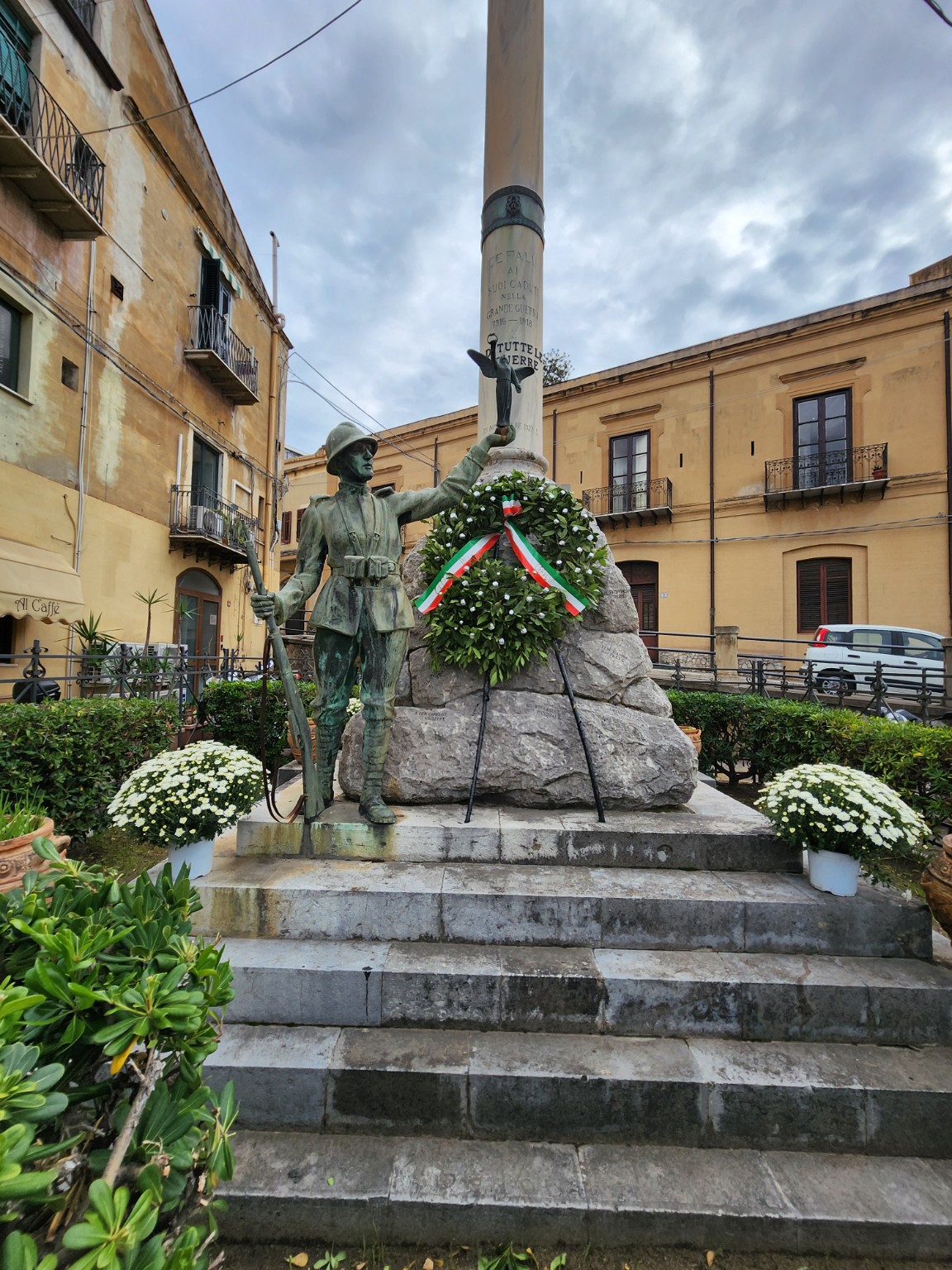
This memorial to the fallen of the Great War is one of those places that invites a visitor to stop for a moment. A bronze infantryman stands beside a tall stone column, one hand gripping a rifle while the other reaches upward toward a winged emblem. His uniform, helmet and equipment evoke the Italian soldiers who fought during the conflict of 1915–1918.
The column bears an inscription commemorating the town’s fallen in the Grande Guerra. At its foot is a rugged stone mass, against which a large green wreath has been placed. Its red, white and green ribbons echo the Italian flag. Two generous pots of white chrysanthemums stand symmetrically beside the memorial steps, turning the setting into a carefully tended place of remembrance.
What makes the scene particularly affecting is how naturally it fits into the everyday streetscape. Ochre and cream façades surround the monument, their balconies and shutters unmistakably characteristic of a Sicilian town. Overhead, cables cut across a cloudy sky. A parked car and café frontage remain visible behind the commemorative garden. Life goes on around the memorial, as it should.
The timing of the photograph, in early November, adds meaning. Italy observes the Giorno dell’Unità Nazionale e Giornata delle Forze Armate on November 4, marking the end of Italy’s fighting in the First World War and honoring military service and sacrifice. The fresh wreath and flowers are consistent with that season of remembrance, although the photograph alone cannot establish who placed them or on which day.
For travelers, this is a reminder that Cefalù offers more than its famous postcard views. Its historic streets, local squares and public monuments reveal the relationship between national history and individual communities. The names and inscriptions on memorials such as this one connect the enormous events of the twentieth century to a specific town and its families.
The monument is worth noticing during a leisurely walk through Cefalù, particularly for visitors interested in Italian history, public sculpture or the ways communities remember war. There is no need to rush past it on the way to the beach or cathedral. Its soldier, raised arm, weathered stone and carefully arranged flowers tell a quieter story of Sicily.