At the heart of Palermo, where Via Maqueda intersects Corso Vittorio Emanuele, four monumental Baroque façades face one another across an extraordinary urban crossroads. Quattro Canti, officially Piazza Vigliena, is not merely a beautiful intersection. It is an architectural statement about the city, its Spanish rulers, its historic neighborhoods and the passage of time.
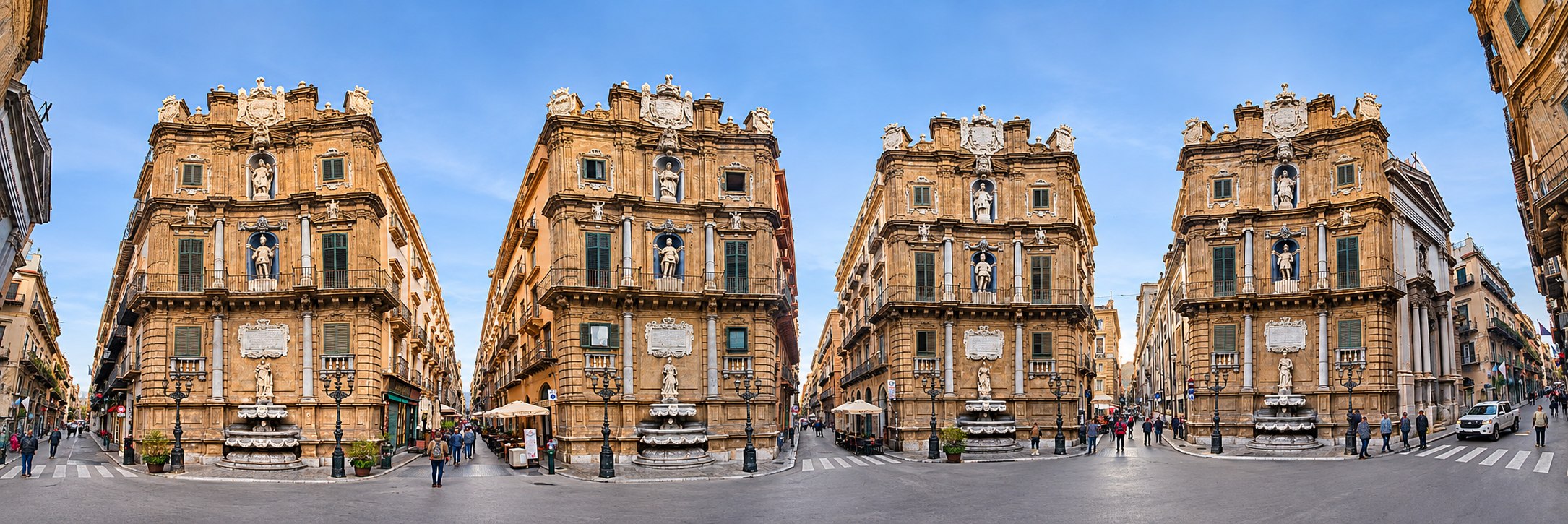
The panoramic photograph reveals the relationship between all four corners better than a conventional single-frame view. The weathered golden-brown stone, shuttered windows, sculpted niches, balconies and ornate coats of arms form a remarkably consistent rhythm. Beneath them, pedestrians, café umbrellas and vehicles bring ordinary modern life into the setting. The image stretches the intersection into a continuous architectural sequence, even though four streets separate the façades.
Palermo’s Spanish administration opened Via Maqueda in 1600, cutting across the older Cassaro, now Corso Vittorio Emanuele. The intersection divided the historic city into four mandamenti: Albergheria, Capo, La Loggia and Kalsa. What might have been a purely functional crossroads became a symbol of a newly ordered city.
Construction began in 1608 to a design by the Florentine architect Giulio Lasso. Mariano Smiriglio continued the work after Lasso’s death, and the main architectural ensemble was completed around 1621, although sculptural decoration continued for decades. Instead of four straight walls, the architects chose concave façades that create an approximately octagonal space. It feels almost like a stage, with the city itself providing the actors.
Each façade follows a deliberate vertical program. At the base is a fountain associated with one of Palermo’s historic rivers, accompanied by a personification of a season: Venus for spring, Ceres for summer, Bacchus for autumn and Aeolus for winter. Above stand the Spanish sovereigns Charles V, Philip II, Philip III and Philip IV. Higher still are the four female saints Christina, Ninfa, Oliva and Agatha, traditionally associated with the districts. Nature, political authority and religious protection rise in successive layers.
The number four governs everything: four corners, districts, fountains, seasons, monarchs and saints. Classical columns and repeated sculptural niches give the separate buildings the appearance of one unified monument. Yet look carefully and each corner tells its own story.
Quattro Canti is also known as the Teatro del Sole, the Theatre of the Sun. As daylight moves across the crossroads, different façades catch the light, changing the balance of illuminated stone and deep shadow. At least one corner receives sunlight during the day. For photographers this means the same scene can look dramatically different from morning to afternoon.
Historically, the square was not always a peaceful place to admire architecture. It hosted public celebrations and executions, prompting an old saying associating Piazza Vigliena with both festivities and the gallows. The beautiful setting was also a stage for the demonstration of power.
Today the crossroads belongs to everyday Palermo. People pass beneath the statues without necessarily looking up, tourists stop to examine the fountains, and commercial life continues around the historic stonework. This is what makes the place so compelling: it has not been removed from the city and turned into a museum exhibit.
The photograph’s soft daylight makes the stone textures particularly legible. Darkened surfaces, recessed shutters, pale marble sculptures and the small figures at street level emphasize the extraordinary scale of the four façades. A panorama introduces perspective distortion, certainly, but it also makes the underlying geometry intelligible in a way a postcard of one corner cannot.
Quattro Canti is an ideal starting point for exploring Palermo. Piazza Pretoria is nearby, and the four streets lead toward historic churches, palaces, markets and distinct neighborhoods. Take a moment to turn slowly in the middle of the crossroads when it is safe, and examine the corners separately before seeing them as one composition again. Four different façades, four districts, one remarkable city.
Background: City of Palermo tourism office; Italia.it.