The Church of Sant’Anna la Misericordia, facing Piazza Sant’Anna in Palermo’s historic center, is one of those buildings that stops you in your tracks. Its sculptural Baroque facade is pressed into the everyday streetscape, with balconies, shutters and weathered residential buildings immediately alongside it.
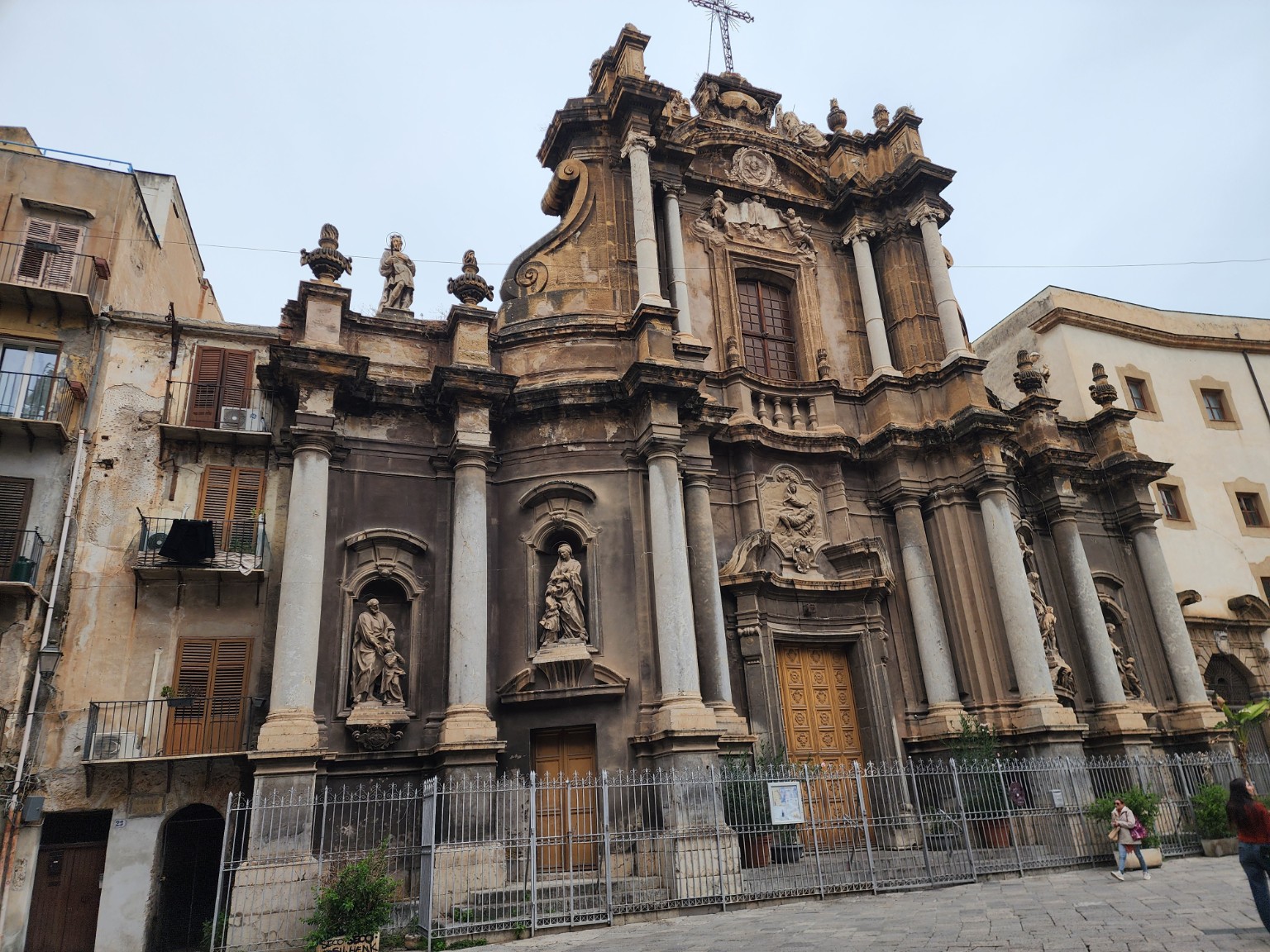
The facade is associated with the eighteenth-century Sicilian architect Giovanni Biagio Amico. Its most striking feature is not merely the richness of its decoration but the way its stone surfaces bend and project. Paired columns rise beside deeply recessed niches, large scroll-like volutes connect the levels, and a tall central window sits above the richly carved wooden entrance. The upper silhouette is animated by sculpture, ornamental finials and a cross.
Look carefully at the relief immediately above the main doorway, the statues in the lower niches and the figures along the roofline. These elements turn the church front into a layered sculptural composition. Even the difference between the lighter columns and darker, weathered masonry adds to its visual depth.
The church’s history also explains its unusual outline. The Baroque front underwent changes following earthquake damage; a third order envisaged in the architectural design was demolished after the earthquake of 1751. What survives is therefore both an ambitious design and a record of the city’s architectural adaptations.
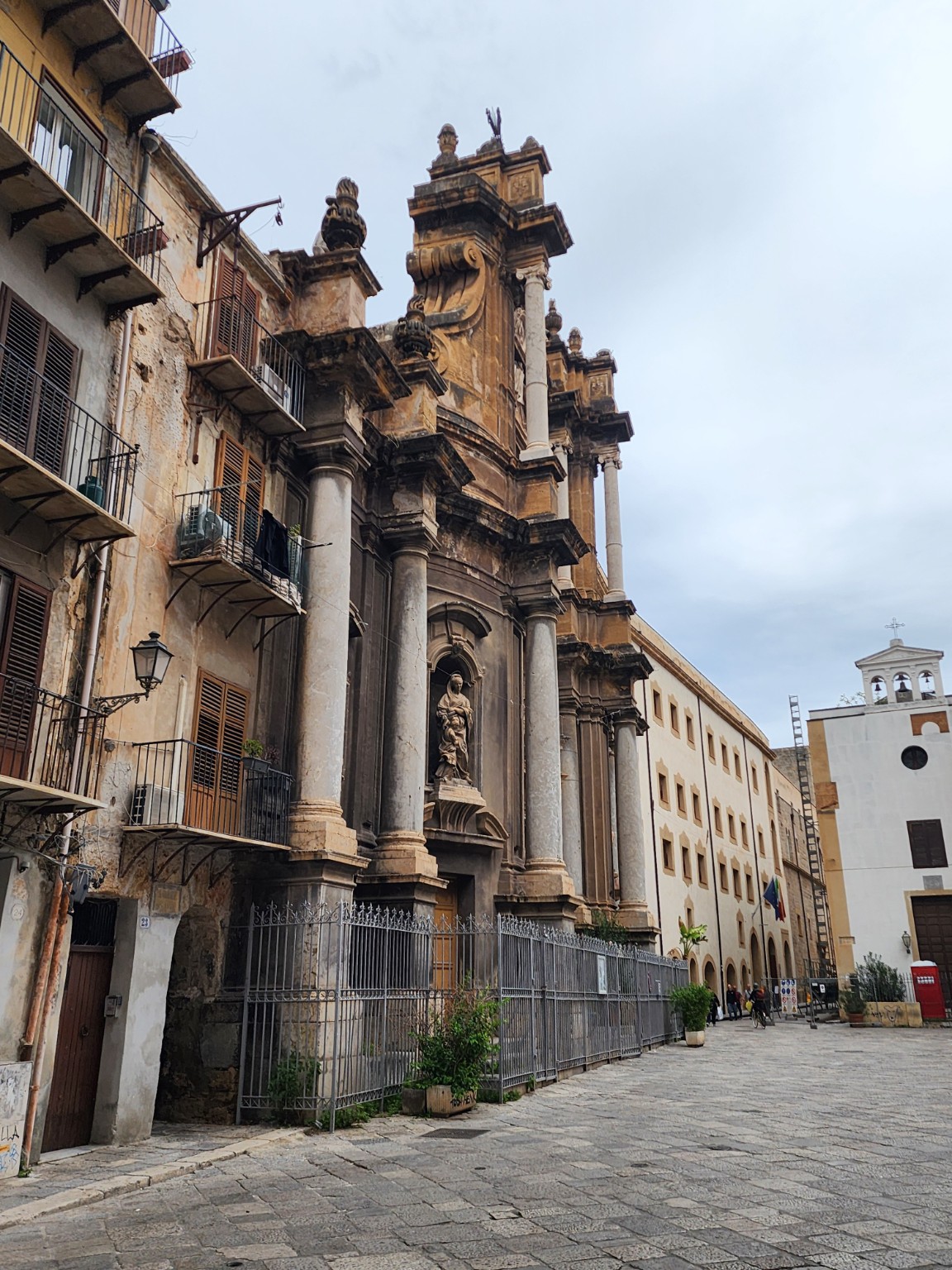
The wider street view reveals another part of the story. On one side, narrow balconies, aging plaster and wooden shutters create an irregular residential frontage. On the other, the church’s massive columns and elaborate stonework dominate the pavement. The metal fence at street level, the potted plants and the worn paving stones make clear that this is a living neighborhood rather than a monument separated from city life.
Piazza Sant’Anna lies in the historic Kalsa area, close to streets associated with the old Lattarini market. This makes it a rewarding stop on a walking exploration of central Palermo: approach from the surrounding narrow streets, step into the square to appreciate the full facade, and then look back from an angle to see how dramatically it rises above its neighbors.
November’s soft, overcast light is particularly good for observing the architecture. It reduces harsh shadows and brings out the stone textures, sculptural recesses and differences in weathering. For photographers, the frontal view captures the facade’s composition, while an oblique street-level photograph communicates the scale and urban setting much better.
Sant’Anna la Misericordia is a reminder that Palermo’s architectural treasures are not limited to its cathedral or the famous Quattro Canti. Sometimes the most memorable sight is a church that seems almost too grand for the ordinary street beside it.
For further architectural background, see research on Sicilian Baroque masonry and Sant’Anna’s facade.