For travelers exploring Brittany, Quimper deserves more than a passing stop on the way to the Atlantic coast. The capital of Finistère has much of what makes western France so rewarding to explore: a genuinely old urban center, an unmistakable regional identity, beautiful public spaces and a pace of life that encourages visitors to abandon their itinerary for an hour or two. You can see a great deal of Quimper on foot, but the pleasure of the city lies as much in the time spent between its landmarks as in the landmarks themselves.
The Cathedral of Saint-Corentin is the obvious place to begin. Construction of the Gothic cathedral began in the thirteenth century, and its two slender nineteenth-century spires rise above the roofs of the old town. The streets around it, particularly Rue Kéréon and the area around Place au Beurre, offer an entirely different scale of architecture. Centuries-old half-timbered houses, small shops and crêperies occupy the narrow streets, with the occasional irregular roofline reminding you that this is an old city rather than a modern reconstruction of one.
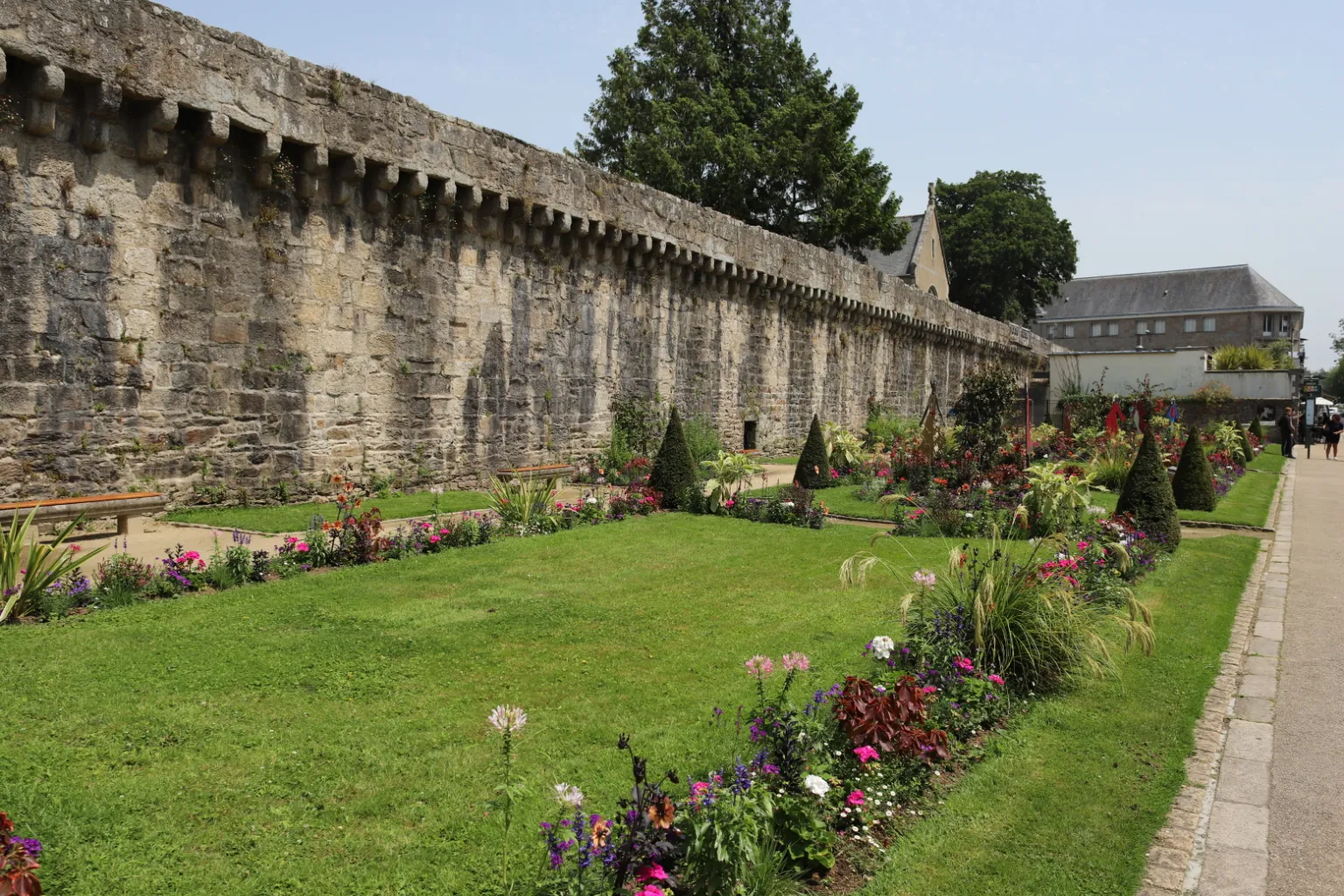
Quimper is also remarkably good at combining historic architecture with horticulture. In the photograph below, a long stretch of weathered stone ramparts forms a monumental backdrop to a meticulously maintained garden. Bright pink, purple, red and white flowers trace the edges of the lawns, punctuated by dark green conical shrubs and tufts of ornamental grass. Wooden benches sit beside the wall, while mature trees and slate-roofed buildings rise behind it. The old masonry, with its repeating projecting stone supports and irregular shades of gray and ochre, could hardly be more different from the soft, colorful planting below. Yet the two belong together. It is a lovely example of how a former defensive structure can become part of a welcoming contemporary city.
There are more gardens to discover elsewhere in the city. The Jardin de la Retraite, sheltered by the old fortifications, contains an unexpectedly exotic collection of plants, including palms and species associated with warmer climates. The neighboring Jardin de la Paix has a Mediterranean character. These are small discoveries rather than attractions that demand an entire afternoon, and that is precisely their appeal. Read more about the city’s architectural and horticultural heritage in our guide to Quimper’s cathedral, medieval walls and gardens.
Another reason to visit is the city’s relationship with water. The Odet and Steïr rivers meet in Quimper, giving the center a series of bridges, riverside paths and perspectives that continually change as you walk. The old episcopal town and the former ducal quarter developed on different sides of the Steïr, and the distinction remains an interesting way of reading the city’s layout. Our photographic walk along the Steïr River explores this quieter side of Quimper, where timber-framed façades and reflections in the water offer some particularly rewarding subjects for photography.
Art lovers should make time for the Musée des Beaux-Arts, beside the cathedral. Its collection ranges from European painting to works associated with Brittany, including artists of the Pont-Aven school. There is also a substantial connection with the poet and artist Max Jacob, who was born in Quimper. Our guide to the Musée des Beaux-Arts de Quimper provides a closer look at the museum. Check its opening arrangements before planning a visit.
Further downstream lies Locmaria, a historic district with a Romanesque church, a former priory and a long tradition of decorated earthenware. Quimper’s faience is one of the city’s most distinctive cultural exports, and a visit to Locmaria helps put the pottery into its original geographical and historical context. The walk from the cathedral along the Odet is worth making even if ceramics are not normally your thing.
Food, of course, is another argument for spending a little longer in Brittany. A buckwheat galette with a savory filling, followed by a sweet crêpe and a glass of local cider, makes an excellent lunch between walks. Look out for kouign-amann, the famously buttery Breton pastry, and give yourself time to browse the food shops and market around the center rather than rushing straight to the next attraction.
A full day is enough for a first encounter with Quimper, although two days allow for museums, gardens and Locmaria at a more comfortable pace. The city also makes a practical base for exploring southern Finistère, with the historic village of Locronan, the fishing ports and walled old town of Concarneau, and the beaches around Bénodet all within reach. Quimper has a railway station, so a visit to the city itself need not depend on hiring a car.
What makes Quimper worth visiting is not a single spectacular monument, impressive though the cathedral is. It is the accumulation of small pleasures: the sight of flowers against an ancient wall, the timber-framed buildings around a corner, the sound of a river flowing through the center, a good lunch and an afternoon that somehow passes without much attention to the clock. Brittany has many dramatic coastal landscapes, but its towns deserve their share of the journey too. Quimper is a particularly good place to discover why.