There are places in France where history is not confined to museums or carefully restored monuments. It is simply there, part of the everyday landscape, standing behind garden walls, rising above old rooftops, and accompanying visitors as they wander through streets that have changed remarkably little in character over the centuries. Quimper, the historic capital of Cornouaille in Brittany, is one of those places.
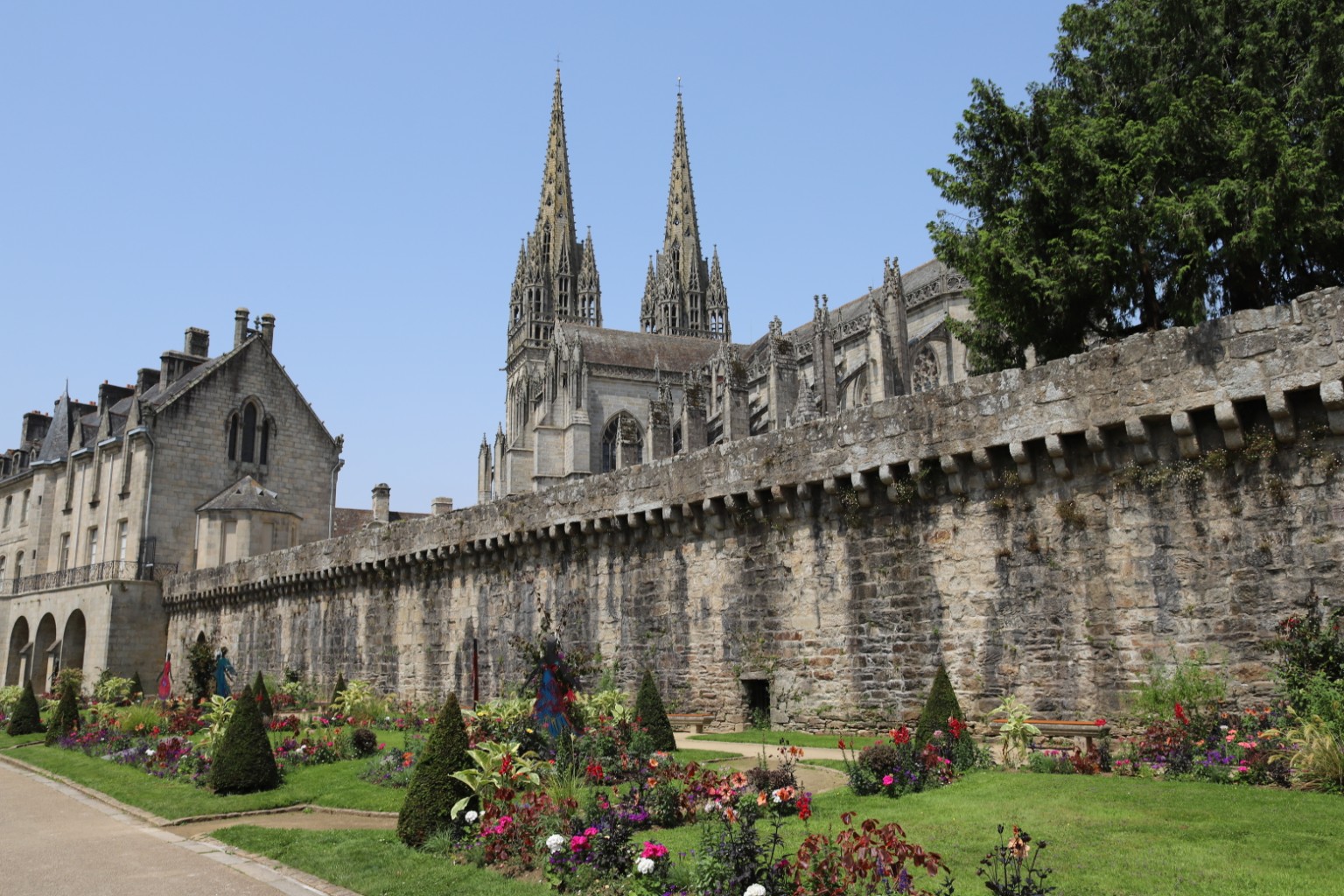
The photograph captures one of Quimper’s most beautiful architectural scenes: the soaring twin spires of Saint-Corentin Cathedral rising above an ancient stone wall, with a carefully maintained public garden spreading across the foreground. It is a wonderful combination of medieval architecture and French horticultural tradition, and it tells much of the story of this charming Breton city without requiring a single word.
The cathedral immediately commands attention. Its two slender Gothic spires, decorated with intricate stonework and delicate pinnacles, reach into a clear blue sky. Although the cathedral’s construction began in the 13th century, its present appearance reflects several centuries of architectural development. The spires themselves were completed in the 19th century, adding a dramatic vertical dimension to a building already celebrated as one of Brittany’s finest Gothic monuments.
From this particular viewpoint, the cathedral appears almost to emerge from behind the massive stone fortifications. The long wall, weathered by centuries of Atlantic weather, stretches diagonally across the photograph, its projecting stone supports creating a strong rhythm of light and shadow. Small plants have taken root in the masonry, softening its imposing appearance. These old walls are reminders of a time when Quimper was a fortified episcopal city, its religious institutions and urban defenses closely intertwined.
In front of the walls lies the Jardin de la Retraite, one of Quimper’s most attractive small gardens. Here, the atmosphere changes completely. Instead of monumental stonework and medieval defenses, the eye encounters bright flowerbeds, carefully clipped conical shrubs, green lawns and winding paths. Red, pink, purple and white blossoms bring life to the foreground, while the garden’s geometric planting contrasts beautifully with the irregular surfaces of the old masonry.
There is something particularly French about this combination. A wall that once served a defensive purpose has become the backdrop for ornamental flowers. A great cathedral, built to express religious authority and spiritual aspiration, now shares its surroundings with people taking a leisurely walk, admiring the gardens or simply enjoying a sunny afternoon. History has not disappeared; it has acquired a gentler setting.
To the left of the photograph stands another substantial stone building, with steeply pitched roofs, tall chimneys, narrow Gothic-style windows and an arcaded ground floor. Its restrained architecture complements the elaborate cathedral behind it. On the right, mature trees rise above the wall, providing a dense green counterweight to the cathedral’s narrow spires. The composition is almost theatrical: flowers in the foreground, fortifications across the middle, and Gothic towers reaching toward the sky.
Quimper itself deserves considerably more attention than it sometimes receives from international visitors. Situated at the confluence of the Odet and Steïr rivers in the Finistère department, the city has long been an important center of Breton culture. Its historic center contains half-timbered houses, narrow pedestrian streets, small squares and traditional shops. Unlike some heavily visited French destinations, Quimper still feels like a working regional city rather than a historic stage set constructed exclusively for tourists.
A walk through the old town reveals another side of Brittany. The region has its own cultural identity, shaped by Celtic traditions, maritime connections, distinctive music and a language that survives alongside French. Local restaurants serve Breton crêpes and savory buckwheat galettes, while shops display the colorful ceramics for which Quimper has been famous for centuries. The city’s traditional faience pottery, often decorated with figures in Breton costume, remains one of its most recognizable cultural products.
Saint-Corentin Cathedral is naturally a major attraction. Visitors approaching from the historic center encounter its imposing western facade, where elaborate Gothic ornamentation frames the entrances and the two towers dominate the surrounding square. Inside, soaring vaults, stained-glass windows and a remarkable choir reward closer examination. One unusual architectural feature is the slight deviation between the alignment of the choir and the nave, a characteristic that has inspired considerable discussion among historians.
Yet the cathedral may be even more memorable when viewed from somewhere unexpected, as in this photograph. Seen from the gardens beyond the old walls, it becomes part of a broader urban landscape rather than an isolated monument. The viewer can appreciate the relationship between religious architecture, medieval fortifications, historic buildings and the green spaces that make Quimper so pleasant to explore.
The Jardin de la Retraite is particularly appealing in warmer months, when seasonal flowers add color to the historic setting. It is a good place to escape the busier streets, photograph architectural details or spend a few quiet minutes before continuing through the old town. Photographers will appreciate the strong diagonal of the wall, the vertical cathedral spires and the opportunities to frame historic stonework against colorful vegetation. The contrast is especially attractive in clear daylight, when the pale granite and limestone surfaces stand out against the blue sky.
Quimper also makes an excellent base for exploring southern Finistère. The surrounding countryside leads toward picturesque Breton villages, wooded river valleys and a coastline of fishing harbors, sandy beaches and rugged Atlantic headlands. The medieval town of Locronan, the artists’ association with Pont-Aven and the coastal scenery around Concarneau are among the region’s many attractions. Visitors with a few days to spare can combine Quimper’s architectural heritage with the very different experience of Brittany’s maritime landscapes.
What makes this photograph particularly appealing is its sense of continuity. The cathedral towers were built across different historical periods, the walls belong to an older defensive landscape, and the flowers represent the ongoing care of the present generation. Each element belongs to a different chapter of the city’s history, yet together they form a remarkably harmonious scene.
France has no shortage of magnificent cathedrals, medieval towns or formal gardens. What makes Quimper special is the way these elements fit together on a comfortable, human scale. You can admire an extraordinary Gothic monument, turn a corner, and find yourself beside a flowerbed or an old stone house. There is no need to rush from one attraction to another.
Sometimes the pleasure of travel comes from discovering precisely this sort of place: a quiet garden, an ancient wall, two Gothic spires above the rooftops, and a little corner of Brittany that seems perfectly content to remain itself.
For visitors exploring western France, Quimper is well worth the detour. And for those already traveling through Brittany, it deserves more than a quick stop on the way to the coast.