From Piazza della Signoria, Florence’s Palazzo Vecchio looks more like a fortress than a palace. Its massive stone walls and soaring tower speak of a city accustomed to political rivalry, while its entrance leads to something quite unexpected: an intimate Renaissance courtyard filled with painted vaults, ornamented columns and a graceful fountain. This is the Cortile di Michelozzo, the first courtyard of Palazzo Vecchio, and a remarkably rewarding place to linger before exploring the museum upstairs.
Redesigned in 1453 by the Florentine architect Michelozzo, the courtyard acquired much of its decorative richness a century later. In 1565, Giorgio Vasari directed its embellishment for the wedding of Francesco de’ Medici and Joanna of Austria. The painted views of cities associated with the Habsburg territories were part of the celebrations, turning the entrance to the seat of Florentine government into an architectural expression of dynastic diplomacy. Renaissance decoration, in this particular setting, was never entirely about aesthetics.
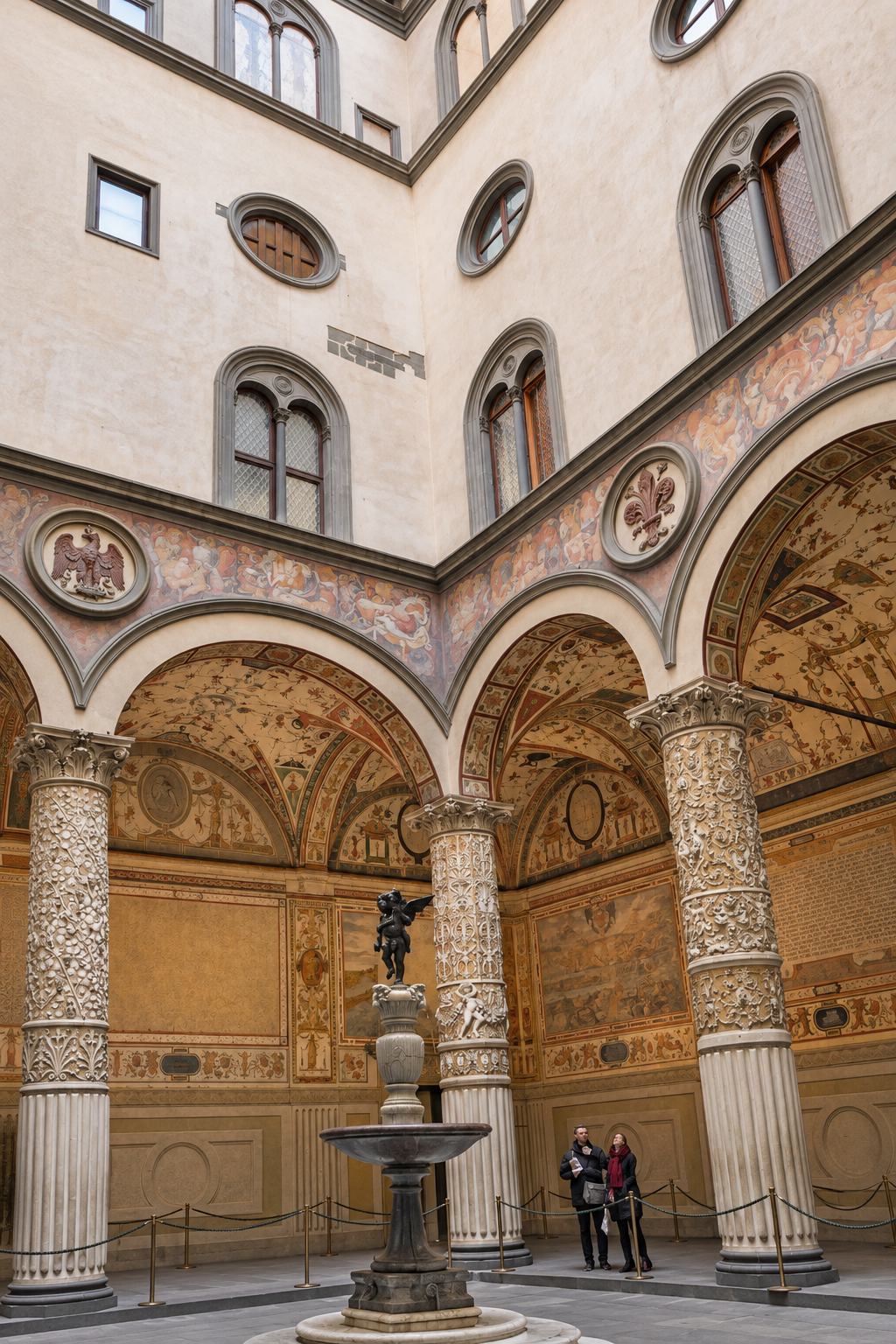
In the photograph, the upward perspective reveals two quite different architectural worlds. The relatively restrained upper walls, punctuated by oval and paired arched windows, rise above a much more elaborate arcade. The columns combine fluted lower shafts with intricate relief decoration, while the arches shelter warm ochre frescoes, delicate ornamental figures and painted architectural borders. Circular heraldic emblems punctuate the frieze, including the unmistakable Florentine lily. Two visitors near the far wall provide a useful sense of scale; without them, it would be easy to underestimate the height of the courtyard.
The little bronze figure standing above the fountain is a replica of Andrea del Verrocchio’s Putto with Dolphin, created in the fifteenth century and brought to Palazzo Vecchio in 1557. The original was subsequently moved indoors for conservation and can be seen in the museum’s Terrace of Juno. The fountain is an unexpectedly playful presence in such a politically charged building. Its small winged figure, raised above the dark basin, gives the courtyard a human scale amid all that elaborate architecture.
For visitors to Florence, the courtyard makes a natural starting point for an exploration of Palazzo Vecchio. Continue upstairs to the Salone dei Cinquecento, the enormous ceremonial hall whose paintings and sculptures communicate the ambitions of Cosimo I de’ Medici, before exploring the palace’s more intimate decorated rooms. Back outside, Piazza della Signoria brings another chapter of Florentine history into view, with the Loggia dei Lanzi, the replica of Michelangelo’s David and the Neptune Fountain all within a short walk. The Uffizi Gallery is immediately nearby.
Architectural photographers might want to spend a few extra minutes here, particularly looking upwards from beneath the arcade. The contrast between the daylight falling into the courtyard and the shaded, richly decorated vaults is part of its visual character. Rather than concentrating exclusively on the fountain, try including the upper windows, the corner of the building and a few visitors in the composition. There is a great deal to discover in a single frame.
Florence has no shortage of Renaissance masterpieces, of course, but the Michelozzo courtyard offers something that a painting displayed on a museum wall cannot quite reproduce: the experience of standing inside a work of art that was also a functioning political space. It is a beautiful introduction to the city’s habit of bringing artistic invention into the very fabric of public life.