Florence can seem almost too familiar before you arrive. Its domes, statues and warm stone facades have appeared in so many photographs that you half expect the city to stand still and reproduce them for you. Then you walk into Piazza della Signoria and something interrupts the picture. In this photograph, that something is an enormous, knotted column of metal, its folds rising above the crowd as if a handful of clay had been squeezed and stretched to the scale of a building. The setting is unmistakably Florence. The encounter is rather less predictable.
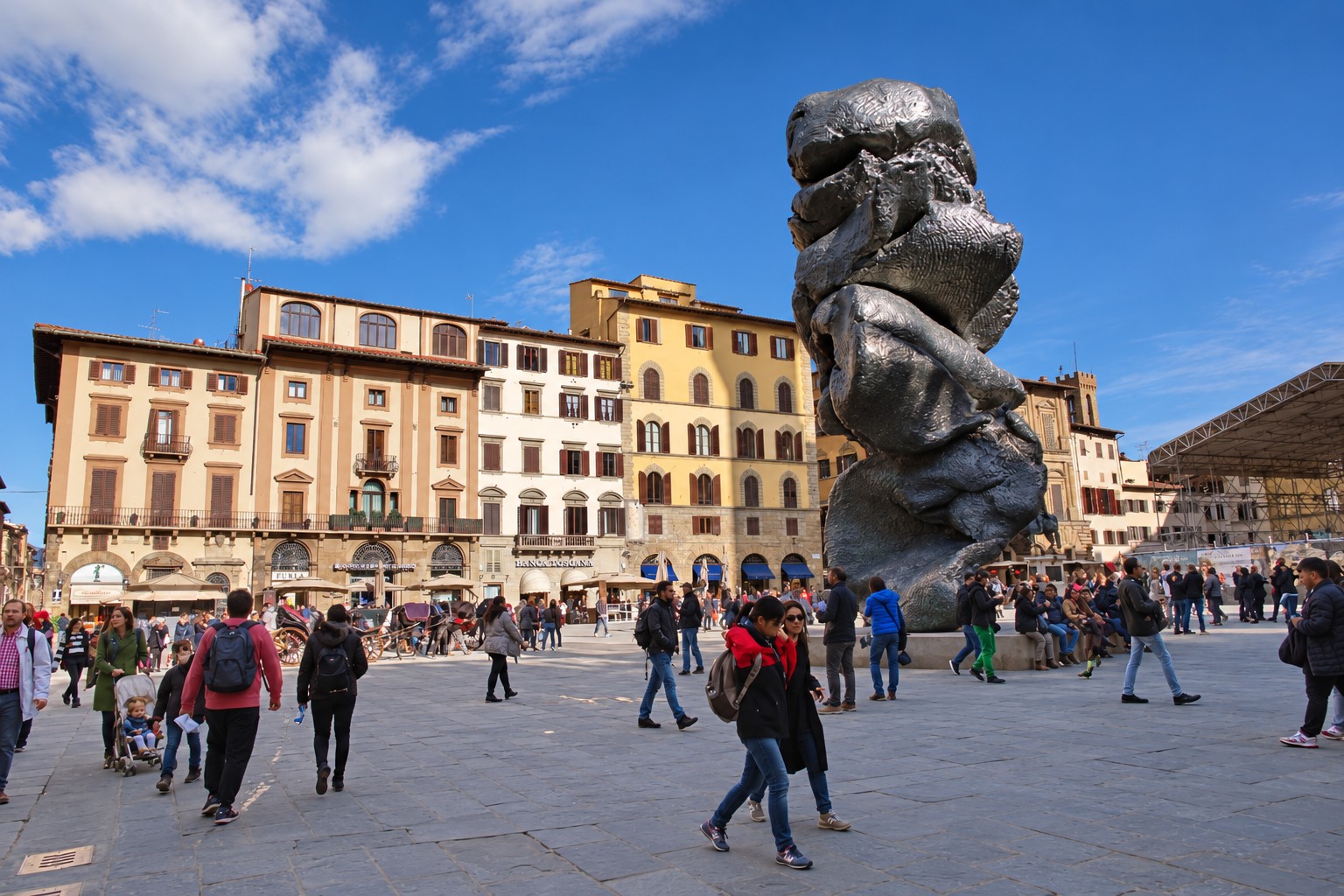
The photograph catches the square in layers. Broad gray paving stones fill the foreground, crossed by visitors wearing backpacks, jackets and bright flashes of red and blue. At the left, a family pushes a stroller past the edge of the frame; nearer the center, two people walk across the scene, absorbed in their own conversation or destination. Behind them, a horse-drawn carriage waits among the movement. Above the shopfronts, cream, pale yellow and dusty pink facades form a closely packed wall of shuttered windows, little balconies and dark rooflines. White clouds drift across an expansive blue sky. And on the right, the sculpture breaks the rhythm completely, its crumpled surface catching silver highlights while its deeper creases remain dark.
The work is Urs Fischer’s Big Clay #4. This is a glimpse of a past installation, rather than a sculpture visitors should expect to find standing in the square today: the artist’s exhibition record dates its Florence presentation from September 22, 2017, to January 21, 2018. That temporary presence is part of what makes the image interesting. A place associated with the permanence of stone and the authority of historical monuments briefly acquired a form that looked unfinished, unstable and insistently handmade. The artist’s exhibition archive records the presentation as Big Clay #4 and 2 Tuscan Men.
There is a pleasing tension between the sculpture and the buildings behind it. The facades depend on repetition: window above window, shutter beside shutter, a steady succession of horizontal lines. Fischer’s sculpture offers almost none of that reassurance. It bulges, twists and narrows. Your eye follows one fold and loses it in another. Set against the orderly architecture, it makes the surrounding buildings look even more composed, while they make its irregularity more conspicuous. You do not have to like the object to find yourself looking longer.
But the people keep the scene from becoming a tidy argument about old and new art. They cross in front of the sculpture, pause at its base, sit nearby or carry on without giving it much attention. The square belongs to these ordinary movements too. For all the weight of Florence’s artistic reputation, this is still a place where someone has a tired child, someone needs to catch up with a friend, and someone has stopped in exactly the wrong spot for another person’s photograph. That small disorder is part of the pleasure.
What stays with me in this view is the way Florence accommodates several scales at once: the intimate business of crossing a square, the repeated windows of the buildings, and a sculpture large enough to challenge the skyline. The photograph preserves a temporary encounter within a much older setting. It also offers a welcome reminder that a city so often treated as a finished masterpiece can still surprise you at street level.