• Skip to main content
  • Skip to secondary menu
  • Skip to footer

Virtual Travel Guide

Top Travel Destinations in Digital Media

  • Sponsored Post
  • About
    • GDPR Compliance Statement
  • Contact

Lisbon Is So Multilayered, Literally

November 2, 2026 By admin

Lisbon is not a city you can understand by looking straight ahead. You have to look up, and sometimes down, because much of its character exists in the space between street level and the rooftops. The Portuguese capital is built in layers: geographical, architectural, historical and unmistakably human. A short walk can feel like moving between several different cities, even when you have barely changed neighborhoods.
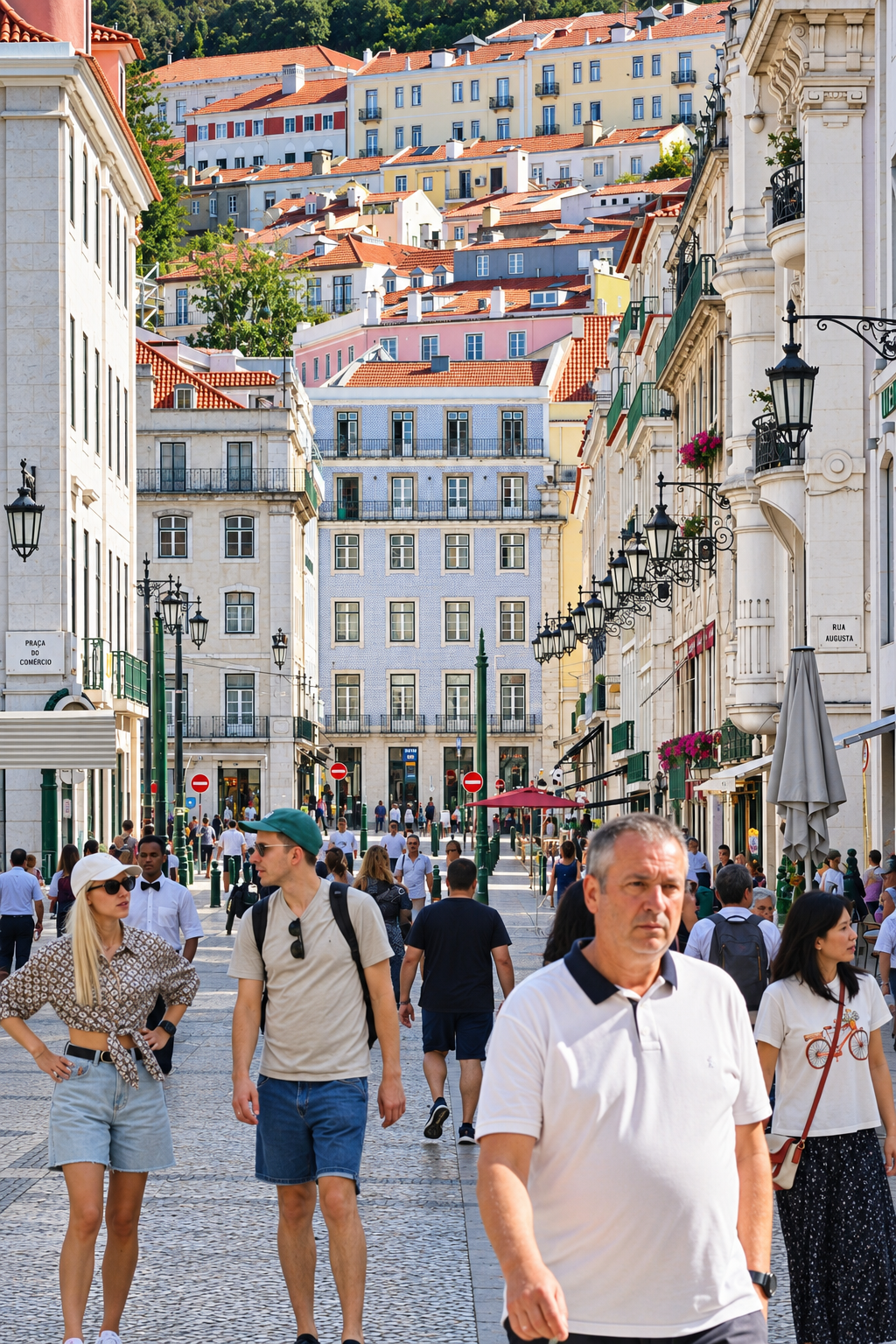
Rua Augusta in Lisbon, with pedestrians beneath layers of colorful hillside buildings and terracotta roofs
From Rua Augusta, Lisbon’s streets and hillside architecture appear stacked one above another.

This view from Rua Augusta, close to Praça do Comércio, makes the point almost too perfectly. The foreground is busy with pedestrians, cafés, shopfronts and the ornate black lanterns of downtown Lisbon. A blue-and-white tiled façade occupies the middle distance. Beyond it, rows of pink, cream, yellow and white buildings climb toward a green hillside, their red roofs overlapping like scales. The eye keeps discovering another terrace, another balcony, another row of windows. The city seems to continue upward long after the street itself has ended.

That visual density is no accident. Lisbon developed around steep hills beside the Tagus estuary, and its neighborhoods have always had to negotiate the terrain. The familiar description of Lisbon as the city of seven hills is useful shorthand, even if the actual topography is more complicated. Streets turn into staircases, routes that appear close on a map can involve exhausting climbs, and a building’s ground floor on one side may sit several stories above the street on the other.

But there is a second layer to the photograph: the difference between the ordered downtown and the more irregular city above it. Baixa was comprehensively rebuilt after the devastating earthquake, tsunami and fires of 1755. Under the direction of the Marquis of Pombal and his planners, the district acquired its broad, relatively regular streets and disciplined blocks. Rua Augusta belongs to that rebuilt urban landscape. Look beyond its orderly corridor and the city becomes more varied, more compressed and less predictable.

The reconstruction was more than a cosmetic exercise. The Pombaline buildings incorporated innovative structural ideas intended to improve earthquake resistance, while the new street plan expressed an unusually systematic approach to urban design for its time. The result is one of Lisbon’s great contrasts: a rational eighteenth-century downtown set against hillsides shaped by different periods of growth and adaptation. You can see that contrast without entering a museum. It is written into the view.

Tiles add another dimension. The azulejo-clad building in the center of the photograph is not simply a colorful backdrop. Ceramic tiles are among Lisbon’s defining architectural surfaces, capable of turning an ordinary façade into a shimmering pattern that changes with the light. They appear on churches, apartment buildings, stations and modest streets, sometimes as elaborate narrative panels and sometimes as repeating geometric designs. In strong afternoon sunshine, they can make a whole street feel brighter.

Lisbon also layers movement. Trams climb gradients that would be awkward for larger vehicles, funiculars and elevators help bridge differences in height, and pedestrians constantly make small decisions between the scenic route and the easier one. A viewpoint such as Miradouro de Santa Luzia or Miradouro da Senhora do Monte offers the grand panorama, but the more intimate discovery is often a glimpse between buildings. Turn a corner, stop at a crossing, or look backward down a street you have just walked, and suddenly the rooftops align into a composition that no guidebook could have planned for you.

There is a practical lesson here for visitors: do not try to see Lisbon only as a checklist of monuments. Give yourself time to wander through Baixa, climb toward Chiado or Alfama, pause at a miradouro, and then descend by a different route. Comfortable shoes matter more than an ambitious itinerary. Distances can be deceptive, and the reward for taking your time is discovering how neighborhoods connect vertically as well as horizontally.

The people in this photograph are part of the story too. Some are heading toward the river, others are shopping, working or simply passing through. Their everyday movement fills the lowest layer of a scene whose upper layers record generations of building, rebuilding and living on difficult terrain. That is what makes Lisbon so photogenic: the city offers not just pretty façades, but depth, texture and the feeling that another story is waiting just above the frame.

Lisbon is multilayered in its history and culture, certainly. Yet the first thing you notice, standing on Rua Augusta and looking toward the hills, is that it is multilayered quite literally.

Filed Under: News

Footer

Recent Posts

  • Campo San Bartolomeo at Night, Venice’s Living Stage Near Rialto
  • The Art of Doing Nothing at a French Café
  • Pena Palace, Sintra, Portugal’s Extraordinary Hilltop Fantasy
  • Cefalù, A Colorful Stairway Through the Old Town
  • Bilbao in the Rain, A Different Kind of Urban Beauty
  • Mont Saint-Michel, Normandy’s Medieval Island Rising Above the Tidal Sands
  • Quattro Canti, Palermo’s Magnificent Baroque Crossroads and Theatre of the Sun
  • The Garden Court of the Frick Collection, A Hidden Architectural Treasure in New York City
  • Palermo, Monreale and Cefalù in 41 Photographs
  • Islamic Art Elements in Palermo Cathedral, Sicily’s Arab-Norman Masterpiece

Part of the Market Research Media network. All publications.

Travel Marketing

  • Travel Marketing
  • Timey.org
  • Ancient Rome
Vienna, Bratislava and Prague in Seven Days by Train
Why I Always Visit the Food Market First in a New City
The Silk Road Today, From Xi’an to Istanbul and Which Stretches You Can Travel
Lisbon Travel Guide, What to See, Where to Swim and What Changed in 2026
Five Days in Venice, a Day-by-Day Itinerary From San Marco to Torcello
The Battle Etched in Plaster — Prague’s Renaissance Sgraffito Story
Borough Market Restaurants, Michelin Picks for a London Food Landmark
Michelin Guide Czechia 2026 Adds Four New Stars, All of Them in Prague
Don’t Be That Tourist in Amsterdam
Toledo Cathedral, Why the City Deserves More Than a Day Trip
Carlo Alberto dalla Chiesa, A Memorial to the General Who Challenged the Mafia in Palermo
Madrid Across Time, the Emilio Castelar Monument Between History and Modern Life
Glenfinnan Viaduct Carries the Jacobite Steam Train Past the Spot Where the 1745 Rising Began
Why Cities Keep Rebuilding Their Past
How Historic Interiors Teach Us to Behave
Alte Nationalgalerie in Berlin and the Art of Looking Across Centuries
Villa Pacini and Catania's Headless Bourbon Kings
Historical Reenactment Shows and the Desire to Watch the Past Come Alive
Spain’s National Day 2026: A Ceremony of Continuity, a Government Nearing Its End?
Vienna Secession: The Golden Dome That Declared Art's Freedom
Sheffield Researchers Recreate the Lycurgus Cup Effect and Show How Hard the Roman Trick Was
Roman Road Milestones Were the First Navigation System
Caligula: What the Sources Say About the Mad Emperor, and What They Invented
Piranesi's Altar to Apollo and the 18th-Century Business of Selling Ancient Rome
Juno Moneta: How a Roman Goddess Gave Us the Words Money and Mint
Julius Caesar's 44 BCE Denarius: The Coin That Helped Get Him Killed
Half of This Roman Mosaic Glass Bowl Is Plaster, and the Smithsonian Kept It
George Loring Brown's Temple of Peace Painting and the Roman Forum's Most Misnamed Ruin
The Badminton Sarcophagus Was Carved While the Roman Empire Was Coming Apart
A Freed Slave in Augustan Rome Paid to Have His Wrinkles Carved in Marble

Media Partners

  • Travel Market
  • Travel Magazine
Visiting Borough Market in London, Free Entry and the Best Time to Go
Kraków Main Market Square, Free to Explore With History Above and Below Ground
Teatro Massimo in Palermo, A €14 Tour Inside Italy's Largest Opera House
Paris Croissant Prices in 2026, Most Bakeries Still Charge 1.10 to 1.40 Euros While Palace Versions Pass 4
Top 10 Travel Destinations Ranked by Nightlife, From Berlin to Bangkok
Palermo Cathedral Is a Landmark You Can Appreciate Before Buying a Ticket
Palatine Chapel Mosaics Make a Strong Case for Prioritizing One Palermo Interior
Palermo Rooflines Reward Travelers Who Look Beyond the Main Attractions
Palermo in the First Week of November 2026, Le Vie dei Tesori Sites From 3 Euros and a Free Baroque Concert
Salamanca Travel Guide: Cathedrals, University and the Golden City
Saint-Émilion: The Wine Town Built From Its Own Underground Quarries
Folk Dances in Bergerac: When Visitors Join the Celebration
Lisbon's Monument to the Discoveries, Framed by Belém Marina
Porto Ribeira Waterfront, Houses and Balconies Above the Douro
Belém Tower and the Busy Lisbon Waterfront
Palermo's Politeama, Where Monumental Architecture Meets Everyday Sicilian Life
Stockholm City Hall Council Chamber and Its Viking Inspired Ceiling
Palermo, Sicily's Most Cinematic and Photogenic City
Wrocław Cathedral, Gothic Towers and the Resilience of a Polish City
Palermo Courtyards Reveal a More Intimate Side of the City

Copyright © 2022 VirtualTravelGuide.com

Market Analysis & Market Research