Most visitors to Bordeaux’s Place de la Bourse stop at the riverfront to photograph the golden crescent of facades and the famous Miroir d’Eau. Few wander through the doorway on the square’s south corner, into the courtyard of the Hôtel des Fermes du Roi, now home to the Musée National des Douanes. That courtyard holds one of the city’s more overlooked set pieces: a monumental wall fountain built in 1738, tucked against the stone where nobody expects to find it.
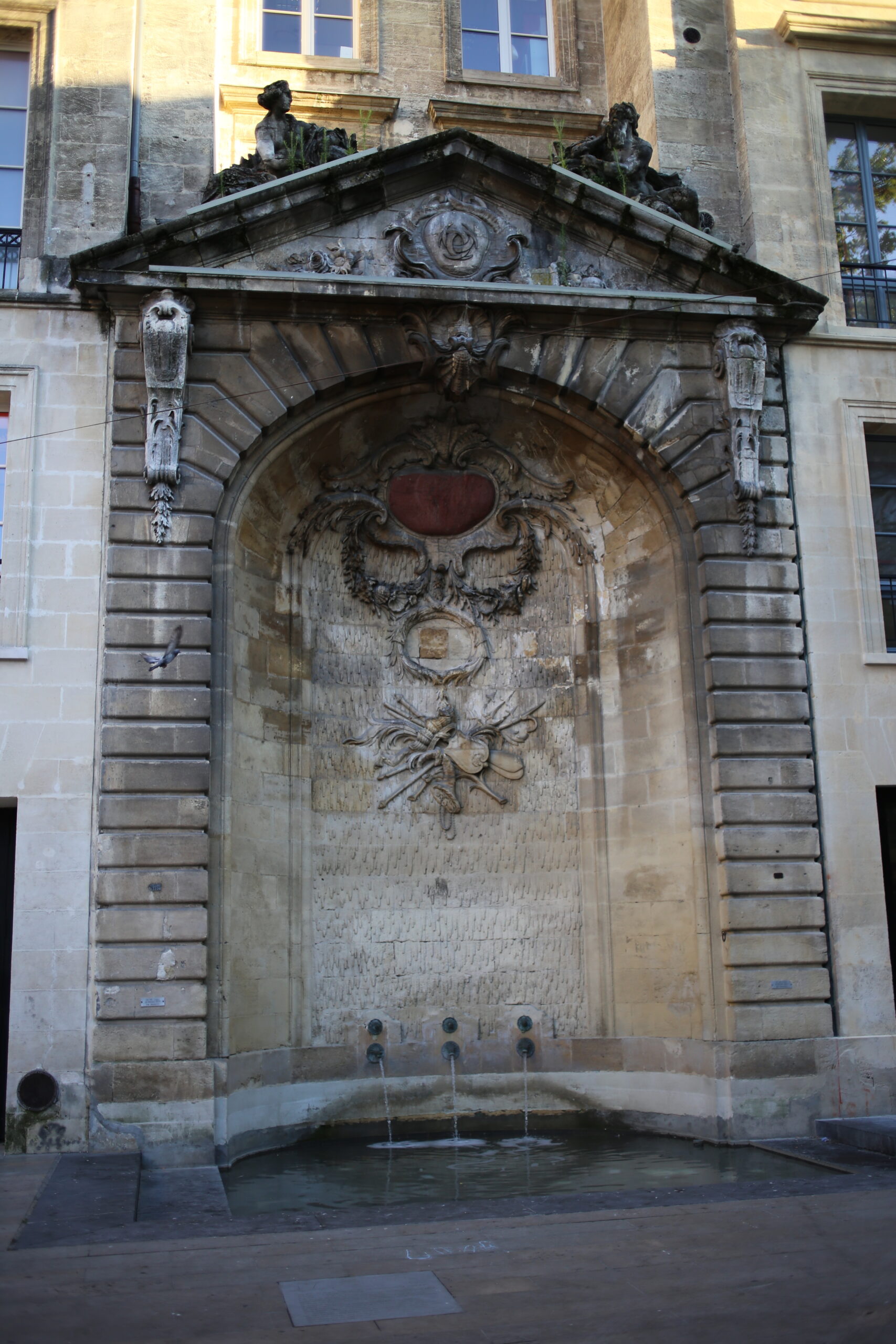
A Fountain Designed to Dress Up a Blank Wall
The building itself went up between 1730 and 1751 under royal architect Jacques-Jules Gabriel, the same figure behind much of Bordeaux’s 18th-century urban makeover. The fountain was added specifically to cover the plain wall that separated the courtyard from the neighboring street, and the job went to Jacques Verberckt, a Flemish decorative sculptor who also carved the building’s two pediment tympana facing the square and the quay.
Locally it’s known as the “fontaine à congélations,” a name that refers to its dripping, icicle-like rocaille ornament rather than any connection to cold. Carved from Taillebourg stone, the composition includes a pair of naiads, a Neptune mask, and a lion’s head worked into the surrounding scrollwork — water imagery for a building that once processed goods arriving straight off the Garonne.
From Tax Collection to Customs Museum
Before it was a museum, this was the Hôtel des Fermes du Roi, seat of the Ferme Générale — the private company that collected royal duties and taxes on incoming merchandise under the Ancien Régime, and the direct ancestor of the modern French customs administration. Goods were unloaded and inspected in the courtyard before passing into the great hall that now houses the museum’s collections.
That history likely explains the blank shield set into the fountain’s central cartouche. Coats of arms tied to royal or tax-collecting authority were routinely chiseled off public monuments during the Revolution, and this one appears to have never been restored — a small, deliberate gap in an otherwise ornate composition.
Still Standing, Rarely Seen
The fountain earned Monument Historique protection in 1914, decades before the surrounding building’s facades and roofs were listed in 1961. It no longer runs with water day to day, and the courtyard itself stays closed to casual visitors — the exception being the Journées du Patrimoine each September, when the museum opens the space for a weekend.
For anyone already spending time at Place de la Bourse, it’s worth checking whether the customs museum’s courtyard happens to be open. It’s a small detour that turns a photogenic square into a much longer story about trade, taxation, and one Flemish sculptor’s take on a very ordinary problem: what to do with a blank wall.