Most people meet the Teatro Politeama on their way somewhere else. You come up Via Ruggero Settimo from the old town, the street opens out, and there it is: a big ochre drum of a building with a triumphal arch stuck to the front and bronze horses rearing off the roof. It’s hard to walk past without stopping. So don’t.
Cross to the far side of the square first. Up close the theatre is all columns and railings, and the bronze on top disappears behind the cornice. From the kerb by the traffic lights you get the whole thing in one frame. The arch, the two tiers of columns curving away on either side, the palms out front, and the chariot riding the skyline. That’s the view in the photo below, taken in the late afternoon, when the stone goes warm and the sky over Palermo still has some blue left in it.
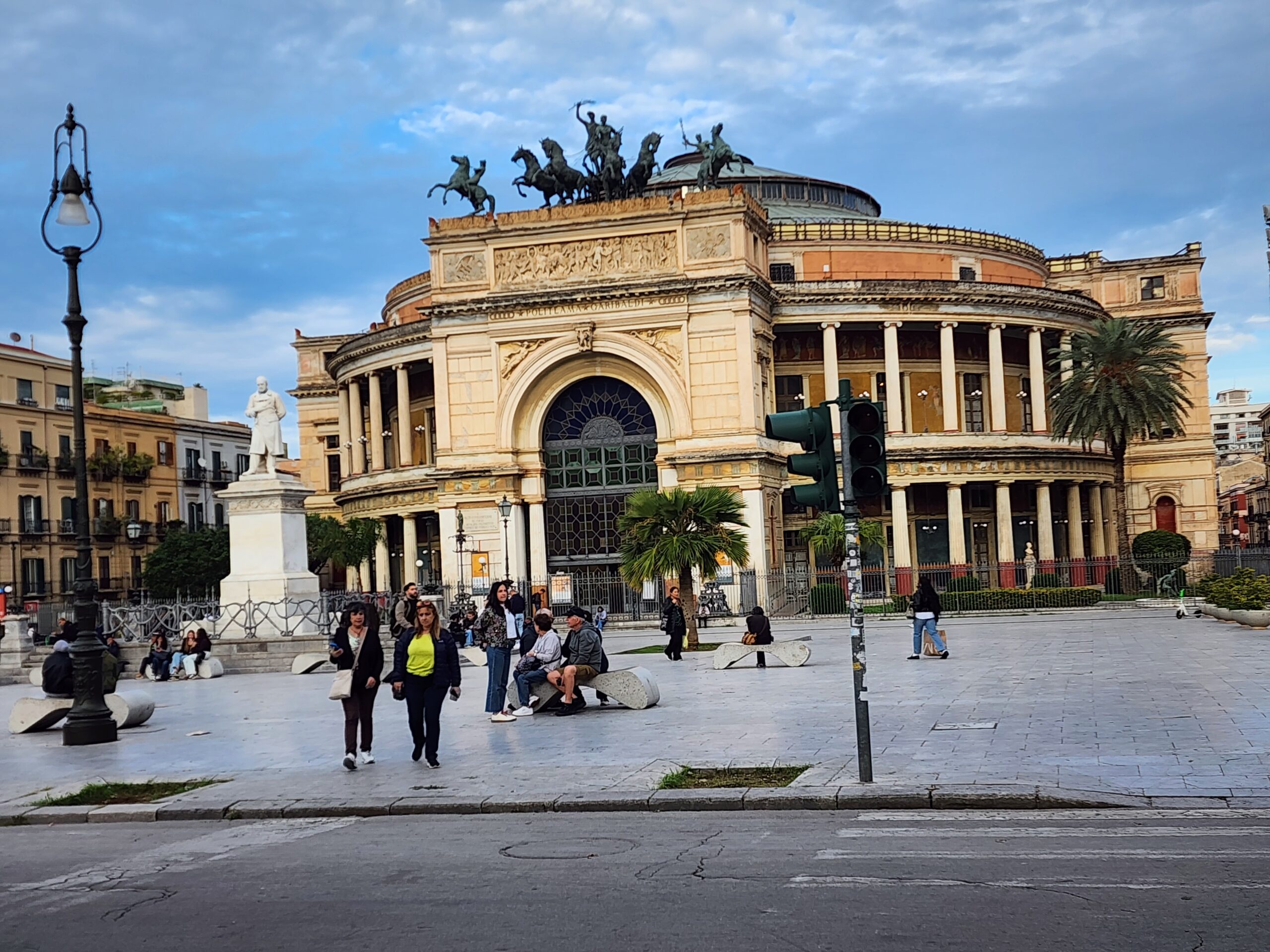
Giuseppe Damiani Almeyda designed it in the second half of the 1800s, when the city was pushing north out of its medieval core and wanted new buildings to show it. He went for Pompeii rather than Paris. Look at the band of red and gold painted figures running under the upper colonnade. That’s the giveaway, and it’s why the place looks more like a Roman villa turned inside out than a typical Italian opera house.
The roof is the part everyone photographs. The bronze quadriga in the middle is by Mario Rutelli, with Apollo and Euterpe driving four horses. The two riders flanking it are by Benedetto Civiletti. They’re lit at night, which is worth a second visit after dinner if you’re staying nearby.
Inside, and what’s playing
The Politeama is a working theatre, home to the Orchestra Sinfonica Siciliana, so the easiest way in is a concert ticket. Guided visits run on many days too and take you into the horseshoe auditorium and the painted rooms off it. Check the box office by the main gate for the current schedule. The front of the building faces the piazza and the side entrances are where the posters go up.
Using the square
Piazza Politeama, officially Piazza Ruggero Settimo, is the hinge between old Palermo and the 19th-century city. Locals use it as a meeting point. The stone benches fill up in the early evening with students and families, and it’s a good place to sit for ten minutes and watch the city go by. Via della Libertà runs north from here for shopping and Liberty-style villas. Walk south and you’re at the Teatro Massimo in about ten minutes, which makes a natural pair: Palermo’s two great theatres, built in the same decades, in two very different moods.
For a full route through the city, start with the Palermo must-see guide, and if you’re heading the other way into the old centre, don’t miss Fontana Pretoria and Piazza Pretoria.