Bordeaux is never boring because there is always something happening between the places you came to see. You set off to look at a stone gateway and end up watching a waiter negotiate a crowded terrace. You follow a shopping street and find yourself slowing down at a window, then stopping for coffee, then wondering where the last hour went. The city has the grand architecture to reward a carefully planned visit, but its real pleasure is how easily a plan slips away. There is enough going on at street level to keep you curious without requiring a ticket or a reservation.
The photograph catches that feeling beautifully. A narrow street opens towards a monumental gateway, its honey-coloured stone bright in the afternoon sun. Heavy blocks surround the arch, while carved ornament fills the triangular pediment above it. Through the opening, a slender pinkish column stands against the blue sky, making the arch feel almost like a deliberately arranged picture frame. Yet the foreground refuses to behave like an architectural postcard. A man in a striped shirt walks ahead among shoppers and families, café chairs spill along the left-hand side, and a dark awning cuts diagonally across the view. On the right, rough stonework and an exposed drainpipe bring the scene back to ordinary street life. Overhead, a banner announces “La Braderie” and dates in July. Even the monument has to share the view with a sale. Quite right, too.
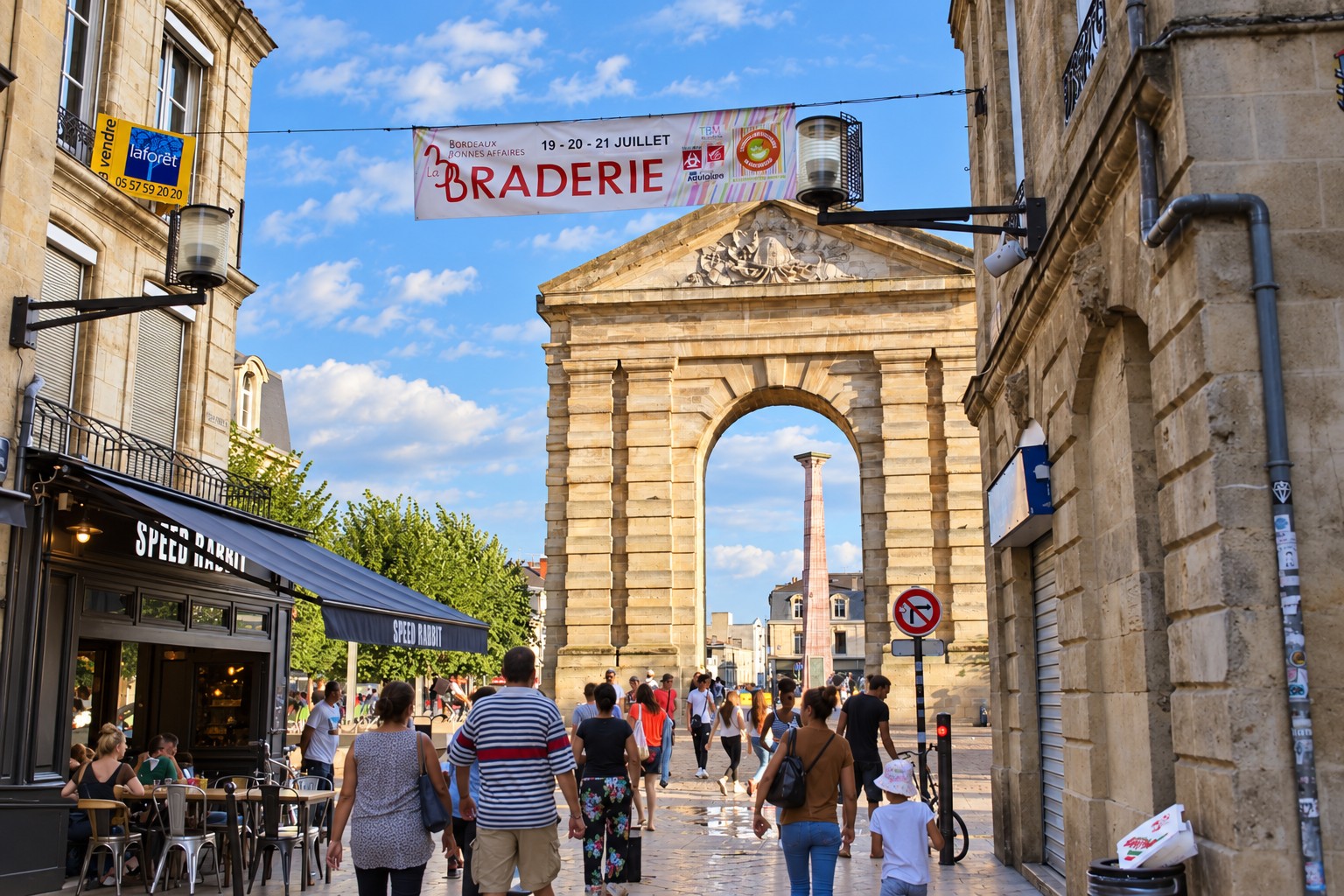
That mixture gives Bordeaux much of its appeal. The pale façades and formal squares could easily make it feel solemn, but then someone rides through the scene, a group gathers outside a bar, or a shop puts something wonderfully unimportant in the window. Around Saint-Pierre, the tighter streets encourage a different pace from the open riverfront. You turn corners rather than scan a distant horizon. A small square becomes a reason to sit down. Later, along the Garonne, the view widens and the sky takes over. Walking between these settings changes the mood of a day without needing to leave the city centre. Our earlier walk through Porte de Bourgogne and historic Bordeaux offers another way into that relationship between monumental entrances and the streets beyond them.
Food provides its own interruptions. A canelé with coffee is a perfectly respectable reason to pause, and lunch can become the central event of an otherwise unstructured afternoon. Bordeaux’s wine reputation is part of the attraction, of course, but you can enjoy the city without turning every meal into a lesson in appellations. Order something you like, watch the neighbouring tables fill, and let the conversation run. For another side of its food culture, Les Halles de Bacalan makes a useful companion to the old-centre café scene. The point is to leave room for appetite to change the route.
There is also plenty to do when wandering needs a little structure. The Bordeaux Fine Arts Museum shifts attention from façades to paintings, and La Cité du Vin introduces a very different architectural language from the limestone streets in the photograph. These changes matter. A city stays interesting when the next part of the day feels different from the last, and Bordeaux lets you move from a close, busy shopping street to a museum or an open stretch of river without making the whole day feel like a transfer between attractions.
Perhaps the best thing about Bordeaux is that it leaves space for a second visit, or simply a second walk down the same street. The light moves across the stone. The café that looked quiet earlier becomes noisy. An arch you photographed from one direction turns out to frame something unexpected from the other. Look again at this scene: the grand gateway is the obvious subject, but the people, the chairs, the banner and the patches of reflected light on the paving give it life. Bordeaux keeps offering both, the handsome view and the small distraction that makes you linger. Boring would require walking through it without ever looking sideways.