The Porte de Bourgogne is a useful place to begin a walk through Bordeaux. Standing on Place Bir-Hakeim at the riverward end of Cours Victor-Hugo, the great stone arch gives the surrounding streets a clear point of reference. The Garonne and the Pont de Pierre lie in one direction; the older city opens behind it. Pause here before choosing a route. The relationship between the gateway, the square and the buildings around it explains quite a lot about Bordeaux.
In the photograph, the arch occupies the left side of the scene, its heavy rectangular crown rising above a single rounded opening. Paired columns stand against deeply jointed stonework, and narrow bands of ornament run beneath the projecting cornice. Behind it, a long sweep of pale limestone façades is topped by dark mansard roofs, curved dormer windows and an uneven procession of chimneys. Slender iron balconies sit beneath tall windows. A branching street lamp overlaps the opening, while a leafy tree softens the buildings to the right. Across the foreground, the paving and low stone parapet give the monument breathing room. There are people passing through, too, which helps keep the scale of all that masonry in proportion.
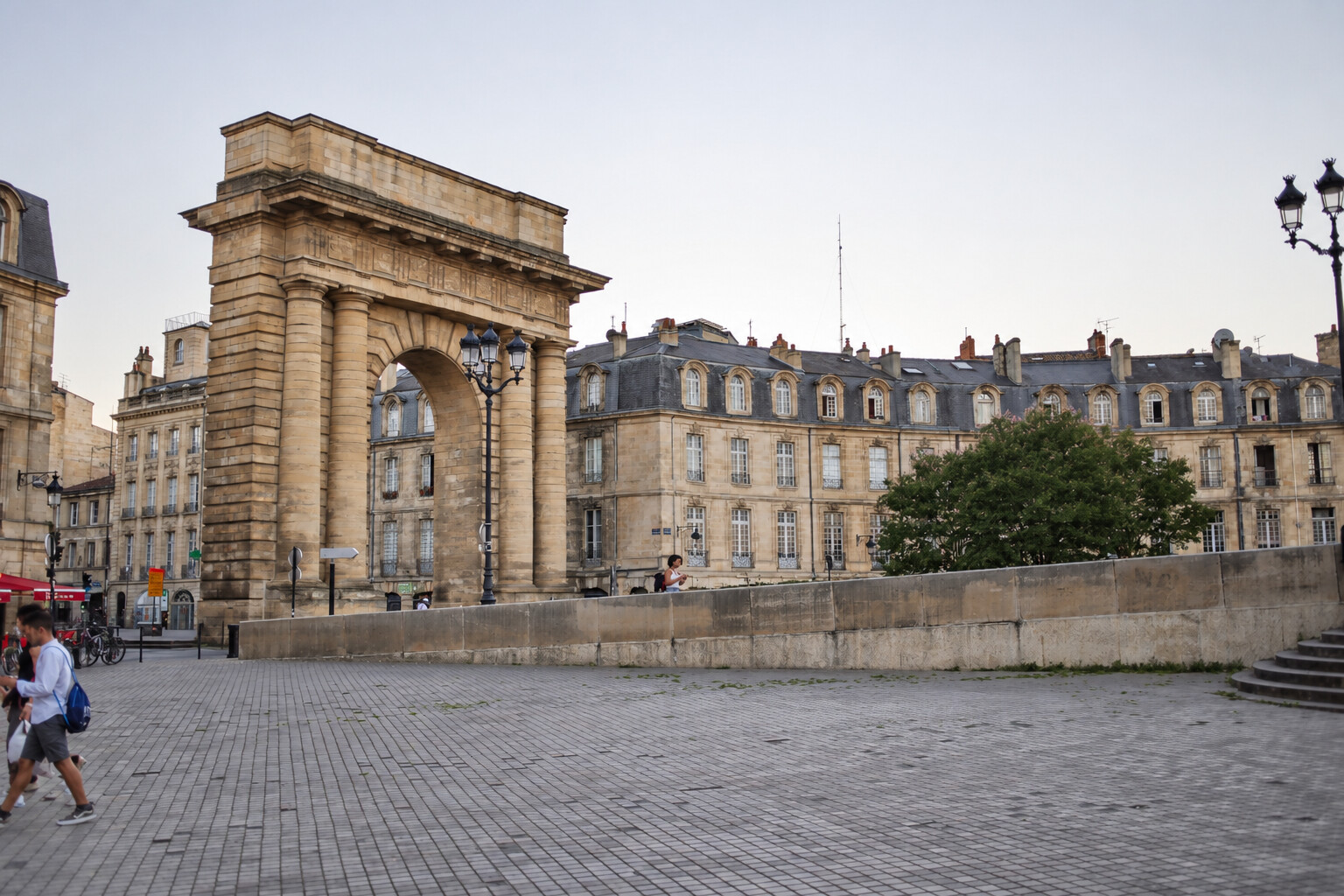
Completed in 1755, the gateway formed part of the eighteenth-century transformation of Bordeaux under the intendant Tourny. André Portier worked on the design, which was reviewed by Ange-Jacques Gabriel. It replaced the older Porte des Salinières and helped give the growing commercial city a more formal entrance. Its architectural language recalls a Roman triumphal arch: a broad central passage, substantial columns and a strong horizontal entablature. The restrained upper section is partly the result of sculptural decoration that was planned but never carried out. Look closely and the simplicity becomes one of its most striking features.
The gateway is older than the bridge it now faces. The Pont de Pierre opened in 1822, linking the historic centre with the opposite bank of the Garonne. Seen together, the two monuments can feel like a single planned entrance, though they belong to different periods. For a view of the bridge itself, move toward the riverbank and look along its repeated arches. Restoration work is taking place on the bridge, so check current access arrangements before making a crossing part of your walk.
From the Porte de Bourgogne, follow Cours Victor-Hugo inland toward the Grosse Cloche, or turn into the streets of Saint-Michel to explore another part of the old city. A riverside walk toward Porte Cailhau and Place de la Bourse offers a different perspective on the limestone façades. If you continue that way, the courtyard fountain at the Customs Museum makes a quieter companion to the grand public spaces. You can build a substantial walk from this one starting point without needing to hurry between distant attractions.
For photographs, give the surrounding architecture some space in the frame. A close view records the arch, but a wider composition shows how it belongs to the city. The roofline, lamps and paving all contribute to the scene. When the sky is bright, the stone beneath the cornice can fall into deep shadow; watch the highlights and leave room to recover detail in the darker areas. Above all, step aside for a few minutes and watch how people use the square. Bordeaux is still going about its day around this eighteenth-century entrance.